


Page 126 - Gas Purification 5E
P. 126
1 16   Gas PiiriJication

                   ings of 0.15 to 0.2 mole C02 per mole amine (0.16 to 0.18 preferred); and a fmal rich solu-
                   tion loading of 0.45 to 0.55 moldmole. Under these conditions, the absorber requires 3 to 4
                   equilibrium stages, and the stripping column requires 6 to 18 theoretical stages. Typical tray
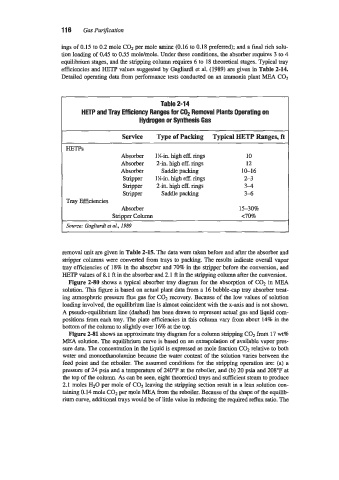
                   efficiencies and HETP values suggested by Gagliardi et al. (1989) are given in Table 2-11.
                   Detailed operating data from performance tests conducted on an ammonia plant MEA COz


                                                 Table 2-14
                         HETP and Tray Efficiency Ranges for C02 Removal Plants Operating on
                                          Hydrogen or Synthesis Gas
                                     Service    Type of Packing  Typical HETP Ranges, ft

                     HETPs
                                     Absorber   1 %in. high eff. rings    10
                                     Absorber   2-in. high eff. rings     12
                                     Absorber    Saddle packing          10-16
                                     Stripper   1%-in. high eff. rings   2-3
                                     Stripper   2-in. high eff. rings     34
                                     stripper    Saddle packing           3-6
                     Tray Efficiencies
                                     Absorber                           15-308
                                  stripper Column                        ~70%
                     Source: Gagliardi et al.,  1989


                   removal unit are given in Table 2-15. The data were taken before and after the absorber and
                    stripper columns were converted from trays to packing.  The results indicate overall vapor
                    tray efficiencies of  18% in the absorber and 708 in the stripper before the conversion, and
                    HETP values of 8.1 ft in the absorber and 2.1 ft in the stripping column after the conversion.
                     Figure 2-80 shows a typical absorber tray diagram for the absorption of  C02 in MEA
                    solution. This figure is based on actual plant data from a 16 bubble-cap tray absorber treat-
                    ing atmospheric pressure flue gas for COz recovery. Because of the low values of solution
                    loading involved, the equilibrium line is almost coincident with the x-axis and is not shown.
                    A pseudo-equilibrium line (dashed) has been drawn to represent actual gas and liquid com-
                                                                      from about 14% in the
                    positions from each tray. The plate efficiencies in this column v  q  7
                    bottom of the column to slightly over 16% at the top.
                     Figure 2-81 shows an approximate tray diagram for a column stripping COz from 17 wt%
                    MEA solution. The equilibrium curve is based on an extrapolation of  available vapor pres-
                    sure data. The concentration in the liquid is expressed as mole fraction COz relative to both
                    water and monoethanolamine because the water content of  the solution varies between the
                    feed point and the reboiler. The assumed conditions for the stripping operation are: (a) a
                    pressure of 24 psia and a temperature of 240°F at the reboiler, and (b) 20 psia and 208°F at
                    the top of the column. As can be seen, eight theoretical trays and sufficient steam to produce
                    2.1 moles HzO per mole of  C02 leaving the stripping section result in a lean solution con-
                    taining 0.14 mole COz per mole MEA from the reboiler. Because of the shape of the equilib-
                    rium curve, additional trays would be of little value in reducing the required reflux ratio. The

