


Page 131 - Gas Purification 5E
P. 131
dlkanolamines for Hydrogen S@de  and Carbon Dioxide Removal   121

                 amount of heat may also be released (or absorbed) by the condensation (or evaporation) of
                 water vapor. To avoid hydrocarbon condensation the lean solution is usually fed into the top
                 of the absorber at a slightly higher temperature than that of the sour gas, which is fed into the
                 bottom. As a result, heat would be transferred from the liquid to the gas even in the absence
                 of acid gas absorption. The heat of reaction is generated in the liquid phase, which raises the
                  liquid temperature and causes further heat transfer to the gas. However, the bulk of  the
                  absorption (and therefore heat generation) normally occurs near the bottom of the column, so
                 the gas is first heated by the liquid near the bottom of the column, then cooled by the incom-
                 ing lean solution near the top of the column.
                   When gas streams containing relatively large proportions of  acid gases (over about 5%)
                  are purified. the quantity of solution required is normally so large that the purified gas at the
                  top of the column is cooled to within a few degrees of the temperature of the lean solution.
                 In such cases essentially all of  the heat of reaction is taken up by the rich solution, which
                 leaves the column at an elevated temperature. This temperature can be calculated by a simple
                  heat balance around the absorber since the temperatures of the lean solution, feed gas, and
                 product gas are known, and the amount of heat released can be estimated from available heat
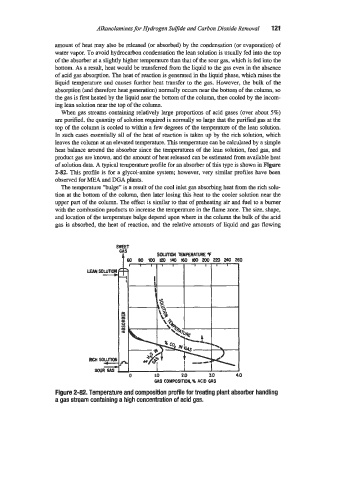
                 of solution data. -4 typical temperature profile for an absorber of this type is shown in Figure
                 2-82.  This profile is for a glycol-amine system; however, very  similar profiles have been
                  observed for ME.4 and DGA plants.
                   The temperature “bulge” is a result of the cool inlet gas absorbing heat from the rich solu-
                 tion at the bottom of  the column, then later losing this heat to the cooler solution near the
                 upper part of  the column. The effect is similar to that of preheating air and fuel to a burner
                  with the combustion products to increase the temperature in the flame zone. The size, shape,
                  and location of the temperature bulge depend upon where in the column the bulk of the acid
                  gas is absorbed, the heat of  reaction, and the relative amounts of  liquid and gas flowing


                  Figure 2-82. Temperature and composition profile for treating plant absoher handling
                  a gas stream containing a high concentration of acid gas.

