


Page 130 - Gas Purification 5E
P. 130
120   Gas Purification


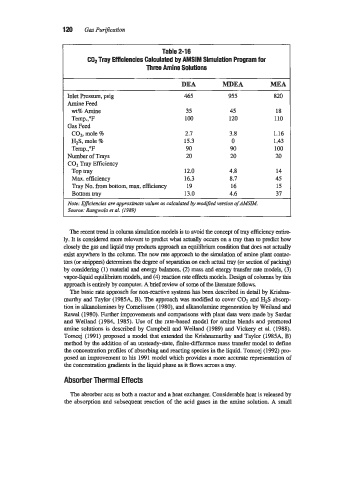
                                                 Table 2-1 6
                           COP Tray Efficiencies Calculated by AMSIM Simulation Program for
                                            Three Amine Solutions

                                                       DEA         MDEA          MEA
                     Inlet Pressure, psig               465          955          820
                     Amine Feed
                      wt% Amine                         35           45            18
                      Temp.,"F                          100          120          110
                     Gas Feed
                      CO1, mole %                       2.7          3.8          1.16
                      H2S, mole %                       15.3          0           1.43
                      Temp.,"F                          90           90           100
                     Number of Trays                    20           20            20
                     CO1 Tray Efficiency
                      TOP tray                          12.0         4.8           14
                      Max. efficiency                   16.3         8.7           45
                      Tray No. from bottom, max. efficiency   19     16            15
                      Bottom tray                       13.0         4.6           37
                     Note: Eficiencies are approximate values as calculated by modified version ofAMSZM.
                     Source: Rangwala et al. (1989)


                      The recent trend in column simulation models is to avoid the concept of tray efficiency en&
                    ly. It is considered more relevant to predict what actually occurs on a tray than to predict how
                    closely the gas and liquid tray products approach an equilibrium condition that does not actually
                    exist anywhere in the column. The new rate approach to the simulation of amine plant contac-
                    tors (or strippers) determines the degree of separation on each actual tray (or section of packing)
                    by considering (1) material and energy balances, (2) mass and energy transfer rate models, (3)
                    vapor-liquid equilibrium models, and (4) reaction rate effects models. Design of columns by this
                    approach is entirely by computer. A brief review of some of the literature follows.
                      The basic rate approach for non-reactive systems has been described in detail by Krishna-
                    murthy and Taylor (1985A, B). The approach was modified  to cover CO, and H2S absorp-
                    tion in alkanolamines by Cornelissen (1980), and alkanolamine regeneration by Weiland and
                    Rawal(l980). Further improvements and comparisons with plant data were made by Sardar
                    and Weiland (1984,  1985). Use of the rate-based model for amine blends and promoted
                    amine solutions is described by  Campbell  and Weiland (1989) and Vickery et al. (1988).
                    Tomcej (1991) proposed a model that extended the Krishnamurthy and Taylor (1985A, B)
                    method by the addition of an unsteady-state, finitedifference mass transfer model to define
                    the concentration profiles of absorbing and reacting species in the liquid. Tomcej (1992) pro-
                    posed an improvement to his 1991 model which provides a more accurate representation of
                    the concentration gradients in the liquid phase as it flows across a tray.
                    Absorber Thermal Effects

                      The absorber acts as both a reactor and a heat exchanger. Considerable heat is released by
                    the absorption and subsequent reaction of  the acid gases in the amine solution. A small

