


Page 133 - Gas Purification 5E
P. 133
Alkanolamines for Hvdrogen Sulfide and Carbon Dioxide Removal   123


                                        1-
                                        2-
                                        3-
                                        4-
                                        5-
                                        6-
                                        7-
                                    F   8-
                                    B
                                    1 ::-


                                    L
                                    P  12-
                                       19-
                                       14  -
                                       15  -
                                       16  -
                                       17  -


                                         80   100   120   140   180   180
                                                Temprature, T
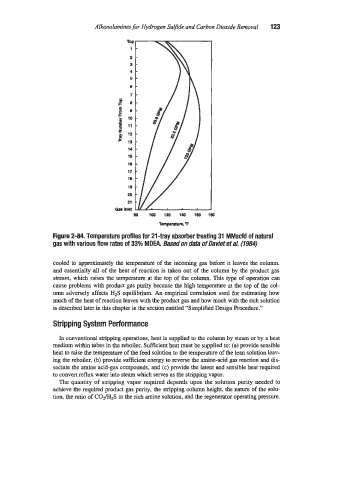
                 Figure 2-84. Temperature profiles for 21 -tray absorber treating 31 MMscfd of natural
                 gas with various flow rates of 33% MDEA. Based on data of Daviet ef a/. (1984)


                 cooled to approximately the temperature of  the incoming gas before it leaves the column,
                 and essentially all of the heat of reaction is taken out of  the column by  the product gas
                 stream,  which raises the temperature at the top of  the column. This type of  operation can
                 cause problems with product gas purity because the high temperature at the top of the col-
                 umn  adversely affects HIS equilibrium. An  empirical correlation used for estimating h0~7
                 much of the heat of reaction leaves with the product gas and how much with the rich solution
                 is described later in this chapter in the section entitled ‘Simplified Design Procedure.’‘

                 Stripping System Performance

                   In conventional stripping operations, heat is supplied to the column by steam or by a heat
                 medium within tubes in the reboiler. Sufficient heat must be supplied to: (a) provide sensible
                 heat to raise the temperature of the feed solution to the temperature of the lean solution leav-
                 ing the reboiler, (b) provide sufficient energy to reverse the amine-acid gas reaction and dis-
                 sociate the amine acid-gas compounds, and (c) provide the latent and sensible heat required
                 to convert reflux water into steam which serves as the stripping vapor.
                   The quantity of  stripping vapor required depends upon the  solution purity needed to
                 achieve the required product gas purity, the stripping column height, the nature of the solu-
                 tion, the ratio of C02/H2S in the rich amine solution, and the regenerator operating pressure.

