


Page 132 - Gas Purification 5E
P. 132
122   Gas PiiriJcation

                    through the column. In general, for C02 absorption, the bulge is sharper and lower in the col-
                    umn for primary amines, broader for secondary amines, and very broad for tertiary amines,
                    which absorb C02 quite slowly and also have a low heat of solution.
                      Since heat is transferred from the hot liquid to the cooler gas at the bottom of the column
                    and in the opposite direction near the top, the temperature profiles for gas and liquid cross
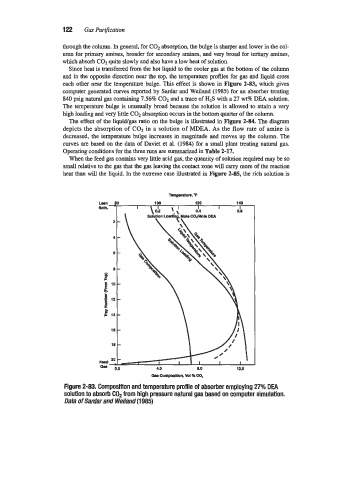
                    each other near the temperature bulge.  This effect is shown in Figure 2-83,  which gives
                    computer generated curves reported by Sardar and Weiland (1985) for an absorber treating
                    840 psig natural gas containing 7.56% C02 and a trace of H2S with a 27 wt% DEA solution.
                    The temperature bulge is unusually  broad because the solution is allowed to attain a very
                    high loading and very little C02 absorption occurs in the bottom quarter of the column.
                      The effect of the liquidgas ratio on the bulge is illustrated in Figure 2-84.  The diagram
                    depicts  the absorption of  C02 in a solution of MDEA. As the flow rate of  amine is
                    decreased, the temperature bulge increases in magnitude and moves up the column. The
                    curves are based on the data of  Daviet et al. (1984)  for a small plant treating natural gas.
                    Operating conditions for the three runs are summarized in Table 2-17.
                      When the feed gas contains very little acid gas, the quantity of solution required may be so
                    small relative to the gas that the gas leaving the contact zone will carry more of the reaction
                    heat than will the liquid. In the extreme case illustrated in Figure 2-85,  the rich solution is


                                                                       12.0
                                              Gas Comporilion, Vol K CO,
                    Figure 2-83. Composition and temperature profile of absorber employing 27% DEA
                    solution to absorb COP from high pressure natural gas based on computer simulation.
                    Data of Sardar and Weiland (1 985)

