


Page 141 - Gas Purification 5E
P. 141
Alkanolaniimes for Hydrogen Suzfide and Carbon Dioxide Removal   131


                 steam ratio (lb stedgal. solution). As noted by  Fitzgerald and Richardson (1966A, B),
                 unstripped CO1 in the solution flowing through the stripping column and reboiler contributes
                 to H2S stripping by increasing the H2S vapor pressure at a given H2S loading. This effect of
                 dissolved COI on the vapor pressure of  H2S is clearly shown in equilibrium charts such as
                 Figure 2-23.  The effect is beneficial in that it reduces the lean amine solution H2S content.
                 However, the reverse effect can occur in the contactor, where the lean amine residual CO?
                 content tends to raise the HIS vapor pressure and increase the HIS content of the treated gas.
                 Fortunately, the net effect is normally beneficial because CO2 stripping continues into the
                 reboiler, and the vapor leaving the reboiler contains both CO? and H2S in equilibrium with
                 the boiling lean solution. Under the same stripping conditions, the partial pressure of either
                 acid gas in the vapor would be less when both acid gases are present than it would be if only
                 the one gas were present. Since the H2S partial pressure in the reboiler vapor represents its
                 equilibrium vapor pressure, it can be expected that the equilibrium vapor pressure of  H2S
                 over the same solution at the contactor feed temperature will also be lower than it would be
                 if only H2S had ken in the reboiler vapor.
                   The follouing discussion provides a chemical equilibrium explanation as to why the pres-
                 ence of another acidic component (such as C02) increases the vapor pressure of H2S over an
                 amine solution. Stripping of  H2S from a primary amine solution can be represented by the
                 following equation:

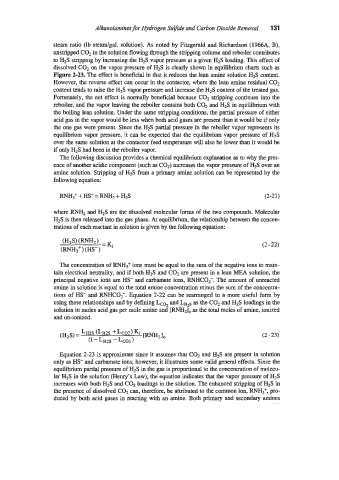
                   FWH3+ + HS- = RNH? + H2S                                     (2-21 )

                 where. RNH,  and H2S  are the dissolved molecular forms of the two compounds. Molecular
                 H2S is then released into the gas phase. At equilibrium, the relationship between the concen-
                 trations of each reactant in solution is given by the following equation:


                                                                               (2 - 23j

                   The concentration of RNH3+ ions must be equal to the sum of the negative ions to main-
                 tain electrical neutrality, and if both HIS and COI are present in a lean MEA solution, the
                 principal negative ions are HS- and carbamate ions, RNHCO,.  The amount of  unreacted
                 amine in solution is equal to the total amine concentration minus the sum of the concentra-
                 tions of  HS-  and RNHC02-.  Equation 2-22 can be rearranged to a more useful form by
                 using these relationships and by defining Lco,  and LHlS as the C02 and HIS loadings in the
                 solution in moles acid gas per mole amine and WH?],  as the total moles of amine, ionized
                 and un-ionized.

                                                                               (2 - 23)


                   Equation 2-23 is approximate since it assumes that C02 and H2S are present in solution
                 only as HS- and carbamate ions; however, it illustrates some valid general effects. Since the
                 equilibrium partial pressure of H2S in the gas is proportional to the concentration of molecu-
                 lar H2S in the solution (Henry’s Law), the equation indicates that the vapor pressure of H2S
                 increases with both H2S and C02 loadings in the solution. The enhanced stripping of H2S in
                 the presence of dissolved CO,  can, therefore, be attributed to the common ion, RNH3+, pro-
                 duced by both acid gases in reacting with  an amine. Both primary and secondary amines

