


Page 234 - Gas Purification 5E
P. 234
220   Gas Purification


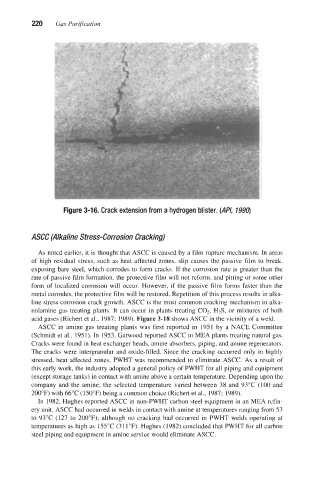
                  Figure 3-16. Crack extension from a hydrogen blister. (AH, 799a)


         ASCC (Alkaline Stress-Corrosion Cracking)

           As noted earlier, it is thought that ASCC is caused by a film rupture mechanism. In areas
         of  high residual  stress, such as heat  affected  zones,  slip causes the passive  film  to break,
         exposing bare steel, which corrodes to form cracks. If the corrosion rate is greater than the
         rate of passive film formation, the protective film will not reform, and pitting or some other
         form of  localized corrosion  will occur.  However,  if  the passive  film forms faster than the
         metal corrodes, the protective film will be restored. Repetition of this process results in alka-
         line stress corrosion crack growth. ASCC is the most common cracking mechanism in alka-
         nolamine gas treating plants. It can occur in plants treating C02, H2S, or mixtures of both
          acid gases (Richert et al., 1987; 1989). Figure 3-18 shows ASCC in the vicinity of a weld.
           ASCC in amine gas treating  plants  was  first reported  in  1951 by  a NACE Committee
          (Schmidt et al., 1951). In 1953, Garwood reported ASCC in MEA plants treating natural gas.
          Cracks were found in heat exchanger heads, amine absorbers, piping, and amine regenerators.
         The cracks were intergranular  and oxide-filled.  Since the cracking  occurred only in highly
          stressed, heat affected zones, PWHT was recommended to eliminate ASCC. As a result of
          this early work, the industry adopted a general policy of PWHT for all piping and equipment
          (except storage tanks) in contact with amine above a certain temperature. Depending upon the
          company and the amine, the selected temperature  varied between  38 and 93°C (100 and
         200°F) with 66°C (150°F) being a common choice (Richert et al., 1987; 1989).
           In  1982, Hughes reported ASCC in non-PWHT carbon steel equipment in an MEA refin-
         ery unit. ASCC had occurred in welds in contact with amine at temperatures ranging from 53
         to 93°C (127 to 200°F); although  no cracking had occurred in PWHT welds  operating at
         temperatures as high as 155°C (31 1°F). Hughes (1982) concluded that PWHT for all carbon
          steel piping and equipment in amine service would eliminate ASCC.

