


Page 231 - Gas Purification 5E
P. 231
Mechanical Design and Operation of Alkanolamine Plants   21 7

      process  leads to cracking.  A summary of each cracking mechanism  follows. Examples  of
      each cracking mechanism are provided in API 945, Appendix A (API, 1990).
      SSC (Sulfide Stress Cracking)

       Carbon steel is embrittled by  atomic hydrogen dissolved in the metal lattice. In the heat-
      affected  zones adjacent  to welds  there are often  very  narrow  hard  zones combined  with
      regions of high residual tensile stress that may become embrittled to such an extent by dis-
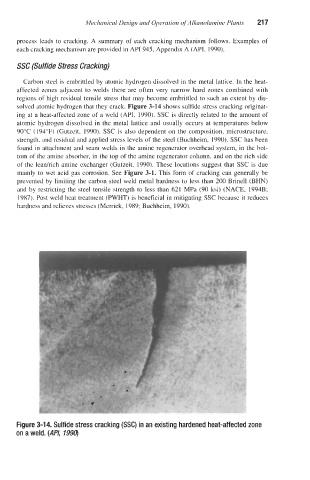
      solved atomic hydrogen that they crack. Figure 3-14 shows sulfide stress cracking originat-
      ing at a heat-affected zone of a weld (API,  1990). SSC is directly related to the amount of
      atomic  hydrogen  dissolved in the metal lattice and usually  occurs at temperatures  below
      90°C  (194°F)  (Gutzeit,  1990). SSC is also dependent on  the composition, microstructure,
      strength, and residual and applied stress levels of the steel (Buchheim,  1990). SSC has been
      found in attachment and seam welds in the amine regenerator overhead  system, in the bot-
      tom of the amine absorber, in the top of the amine regenerator column, and on the rich side
      of  the leadrich amine exchanger  (Gutzeit,  1990). These locations  suggest that  SSC is due
      mainly to wet acid gas corrosion.  See Figure 3-1. This form of cracking can generally be
      prevented by  limiting the carbon steel weld metal hardness to less than 200 Brinell (BHN)
      and by  restricting the steel tensile  strength to less than  621 MPa  (90 ksi) (NACE,  1994B;
      1987). Post weld heat treatment (PWHT) is beneficial in mitigating SSC because it reduces
      hardness and relieves stresses (Menick, 1989; Buchheim,  1990).


            I


            1
      Figure 3-14. Sulfide stress cracking (SSC) in an existing hardened heat-affected zone
      on a weld. (AH, 7994

