


Page 226 - Gas Purification 5E
P. 226
21 2   Gas Pur8cation

                   Heat Stable Salt Neutralization. Soda ash (or caustic soda) is often added to DEA and
                   MDEA solutions to neutralize heat-stable salts, and there is considerable plant evidence that
                   this is an effective means of reducing corrosion (Smith and Younger,  1972; Butwell et al.,
                   1982; Liu and Gregory, 1994; Bums and Gregory, 1995; Liu et al., 1995; Rooney et al.,
                   1996). Adding  soda ash reduces amine solution corrosiveness by raising the solution pH.
                   Soda ash addition may also reduce corrosion by preventing the release of weaker acids such
                   as formic acid during amine regeneration (McCullough and Nielsen,  1996). Although soda
                   ash addition can reduce corrosion, the amount that can be added is limited because solids
                   will eventually be precipitated, plugging equipment and piping.  However, solids precipita-
                   tion and equipment plugging can be avoided if  soda ash addition is combined with amine
                   solution reclaiming using either batch distillation, ion exchange, or electrodialysis. Soda ash
                   addition is particularly attractive for secondary and tertiary amines like DEA and MDEA
                   since these amines cannot be reclaimed during normal operation. Therefore, for these
                   amines, soda ash addition can be used to control corrosion until a contract reclaimer arrives
                   at the plant site.
                     According to Scheinnan (1973A, B), soda ash should first be added to DEA solutions
                   when the heat stable salt concentration reaches 0.5 wt%. Nearly 20 wt% sodium salts can be
                   tolerated before any solids precipitate. Potassium carbonate can also be used to neutralize
                   heat stable salts and has the advantage of being about 25% more soluble by weight than sodi-
                   um compounds (Scheirman, 1973A, B).
                     For MDEA solutions, Liu and Gregory (1994) recommend that soda ash should be added
                   to keep the amine heat stable salts concentration below 2 wt%. The MDEA solution should
                   be reclaimed when the total heat stable salt anion content reaches 4 wt%.  Rooney et al.
                   (1996) have also investigated caustic soda neutralization of MDEA solutions containing heat
                   stable amine salts. They recommend that soda ash addition be used to keep the heat stable
                   amine salts level below  0.5 wt%. In addition, they recommend that individual heat stable
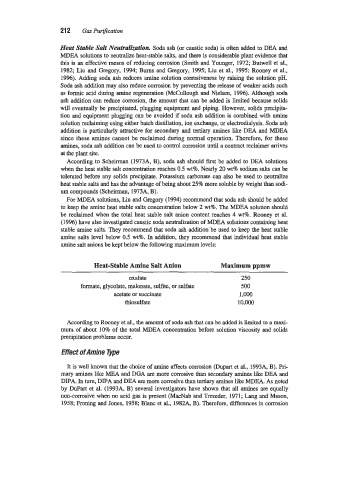
                   amine salt anions be kept below the following maximum levels:

                             Heat-Stable Amine Salt Anion          Maximum ppmw

                                       oxalate                           250
                         formate, glycolate, malonate, sulfite, or sulfate   500
                                   acetate or succinate                 1,000
                                      thiosulfate                       10.000


                     According  to Rooney et al., the amount of soda ash that can be added is limited to a maxi-
                   mum of  about 10% of the total MDEA concentration before solution viscosity and solids
                   precipitation problems occur.
                   Effect of Amine vpe

                     It is well known that the choice of amine affects corrosion (Dupart et al., 1993A, B). Pri-
                   mary  amines like MEA and DGA are more corrosive than secondary amines like DEA and
                   DIPA. In turn, DIPA and DEA ace more corrosive than tertiary amines like MDEA. As noted
                   by DuPart et al. (1993A, B) several investigators have shown that all amines are equally
                   non-corrosive when no acid gas is present (MacNab and Treseder, 1971; Lang and Mason,
                   1958; Froning and Jones, 1958; Blanc et al.,  1982A, B). Therefore, differences in corrosion

