


Page 131 - gas transport in porous media
P. 131
124


                                                                     C
                                    A                B             Costanza-Robinson and Brusseau

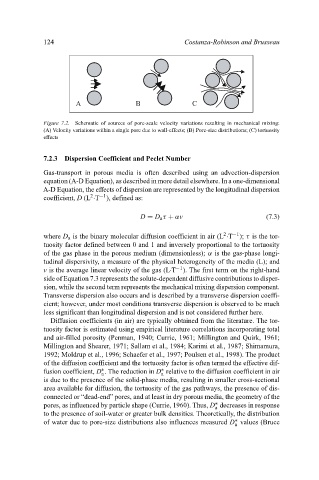
                           Figure 7.2.  Schematic of sources of pore-scale velocity variations resulting in mechanical mixing:
                           (A) Velocity variations within a single pore due to wall-effects; (B) Pore-size distributions; (C) tortuosity
                           effects


                           7.2.3  Dispersion Coefficient and Peclet Number

                           Gas-transport in porous media is often described using an advection-dispersion
                           equation (A-D Equation), as described in more detail elsewhere. In a one-dimensional
                           A-D Equation, the effects of dispersion are represented by the longitudinal dispersion
                                        2
                           coefficient, D (L ·T −1 ), defined as:
                                                      D = D a τ + αv                      (7.3)

                                                                              2
                           where D a is the binary molecular diffusion coefficient in air (L ·T −1 ); τ is the tor-
                           tuosity factor defined between 0 and 1 and inversely proportional to the tortuosity
                           of the gas phase in the porous medium (dimensionless); α is the gas-phase longi-
                           tudinal dispersivity, a measure of the physical heterogeneity of the media (L); and
                           v is the average linear velocity of the gas (L·T −1 ). The first term on the right-hand
                           side of Equation 7.3 represents the solute-dependent diffusive contributions to disper-
                           sion, while the second term represents the mechanical mixing dispersion component.
                           Transverse dispersion also occurs and is described by a transverse dispersion coeffi-
                           cient; however, under most conditions transverse dispersion is observed to be much
                           less significant than longitudinal dispersion and is not considered further here.
                             Diffusion coefficients (in air) are typically obtained from the literature. The tor-
                           tuosity factor is estimated using empirical literature correlations incorporating total
                           and air-filled porosity (Penman, 1940; Currie, 1961; Millington and Quirk, 1961;
                           Millington and Shearer, 1971; Sallam et al., 1984; Karimi et al., 1987; Shimamura,
                           1992; Moldrup et al., 1996; Schaefer et al., 1997; Poulsen et al., 1998). The product
                           of the diffusion coefficient and the tortuosity factor is often termed the effective dif-
                                           ∗
                           fusion coefficient, D . The reduction in D relative to the diffusion coefficient in air
                                                            ∗
                                           a
                                                            a
                           is due to the presence of the solid-phase media, resulting in smaller cross-sectional
                           area available for diffusion, the tortuosity of the gas pathways, the presence of dis-
                           connected or “dead-end” pores, and at least in dry porous media, the geometry of the
                                                                            ∗
                           pores, as influenced by particle shape (Currie, 1960). Thus, D decreases in response
                                                                            a
                           to the presence of soil-water or greater bulk densities. Theoretically, the distribution
                                                                                 ∗
                           of water due to pore-size distributions also influences measured D values (Bruce
                                                                                 a

