


Page 129 - gas transport in porous media
P. 129
Costanza-Robinson and Brusseau
                           122
                           applied to the transport of gases in unsaturated systems, including the concepts of
                           dispersion. However, any rigorous or quantitative analysis of gas-phase systems
                           requires consideration of the unique complexities of unsaturated systems and the
                           properties of gases themselves. For example, unsaturated porous media have air-
                           filled porosities that may vary both spatially- and temporally, and depend on such
                           factors as soil-water content and particle-size distribution. Gas-phase diffusion coeffi-
                           cients are generally four to six orders of magnitude larger than aqueous-phase values,
                           and in contrast to water, gases are significantly affected by pressure-temperature rela-
                           tionships. Gases experience slip-flow along pore walls, often termed the Klinkenberg
                           effect, while water does not. In the following discussion, the authors use the terms
                           “gas” and “vapor” interchangeably, while the term “solute” refers very broadly to the
                           gas/vapor of interest.

                           7.2 THEORY

                           7.2.1  Diffusion
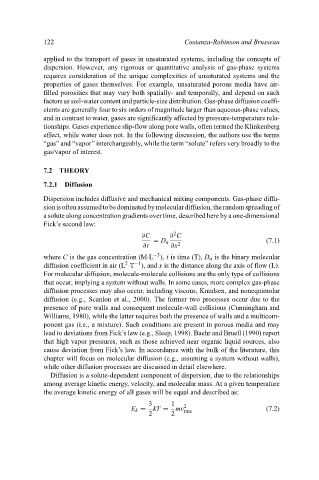
                           Dispersion includes diffusive and mechanical mixing components. Gas-phase diffu-
                           sionis often assumed to be dominated by molecular diffusion, the random spreading of
                           a solute along concentration gradients over time, described here by a one-dimensional
                           Fick’s second law:
                                                                2
                                                       ∂C      ∂ C
                                                          = D a                           (7.1)
                                                       ∂t      ∂x 2
                                                          −3
                           where C is the gas concentration (M·L ), t is time (T), D a is the binary molecular
                                                  2
                           diffusion coefficient in air (L ·T −1 ), and x is the distance along the axis of flow (L).
                           For molecular diffusion, molecule-molecule collisions are the only type of collisions
                           that occur, implying a system without walls. In some cases, more complex gas-phase
                           diffusion processes may also occur, including viscous, Knudsen, and nonequimolar
                           diffusion (e.g., Scanlon et al., 2000). The former two processes occur due to the
                           presence of pore walls and consequent molecule-wall collisions (Cunningham and
                           Williams, 1980), while the latter requires both the presence of walls and a multicom-
                           ponent gas (i.e., a mixture). Such conditions are present in porous media and may
                           lead to deviations from Fick’s law (e.g., Sleep, 1998). Baehr and Bruell (1990) report
                           that high vapor pressures, such as those achieved near organic liquid sources, also
                           cause deviation from Fick’s law. In accordance with the bulk of the literature, this
                           chapter will focus on molecular diffusion (e.g., assuming a system without walls),
                           while other diffusion processes are discussed in detail elsewhere.
                             Diffusion is a solute-dependent component of dispersion, due to the relationships
                           among average kinetic energy, velocity, and molecular mass. At a given temperature
                           the average kinetic energy of all gases will be equal and described as:
                                                         3     1   2
                                                    E k =  kT =  mv rms                   (7.2)
                                                         2     2

