


Page 149 - gas transport in porous media
P. 149
142


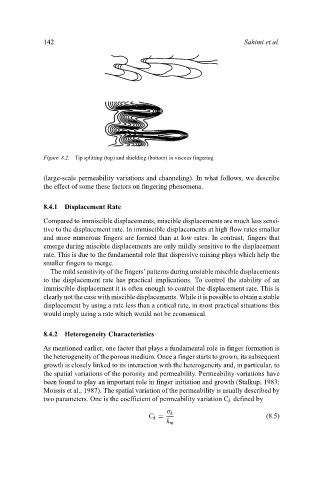
                           Figure 8.2. Tip splitting (top) and shielding (bottom) in viscous fingering  Sahimi et al.

                           (large-scale permeability variations and channeling). In what follows, we describe
                           the effect of some these factors on fingering phenomena.


                           8.4.1  Displacement Rate
                           Compared to immiscible displacements, miscible displacements are much less sensi-
                           tive to the displacement rate. In immiscible displacements at high flow rates smaller
                           and more numerous fingers are formed than at low rates. In contrast, fingers that
                           emerge during miscible displacements are only mildly sensitive to the displacement
                           rate. This is due to the fundamental role that dispersive mixing plays which help the
                           smaller fingers to merge.
                             The mild sensitivity of the fingers’patterns during unstable miscible displacements
                           to the displacement rate has practical implications. To control the stability of an
                           immiscible displacement it is often enough to control the displacement rate. This is
                           clearly not the case with miscible displacements. While it is possible to obtain a stable
                           displacement by using a rate less than a critical rate, in most practical situations this
                           would imply using a rate which would not be economical.


                           8.4.2  Heterogeneity Characteristics
                           As mentioned earlier, one factor that plays a fundamental role in finger formation is
                           the heterogeneity of the porous medium. Once a finger starts to grown, its subsequent
                           growth is closely linked to its interaction with the heterogeneity and, in particular, to
                           the spatial variations of the porosity and permeability. Permeability variations have
                           been found to play an important role in finger initiation and growth (Stalkup, 1983;
                           Moissis et al., 1987). The spatial variation of the permeability is usually described by
                           two parameters. One is the coefficient of permeability variation C k defined by
                                                              σ k
                                                         C k =                            (8.5)
                                                              k m

