


Page 154 - gas transport in porous media
P. 154
147
                           Chapter 8: Gas Injection and Fingering in Porous Media
                           number Pe →∞, where Pe is based on D L or D T and not D m ), fingers form at
                           all length scales, with growth rates that increase with decreasing length scale. This
                           means that a length scale is reached at which a continuum description is no longer
                           appropriate, and one must develop a pore-scale model. Such models will be described
                           below. In this case, the initial-value problem that describes the phenomenon is ill-
                           posed, but one can seek solutions that contain discontinuities. Since dispersion is
                           absent in this case, there will be a step jump in the viscosity profiles (from the gas
                           or the displacing fluid to the displaced fluid). As a result, the pressure obeys the
                           Laplace equation, and the pressure and fluid fluxes are continuous across the front
                           separating the displaced and displacing fluids. One may have all types of singularities
                           in the solution, with different non-uniformities appearing in different boundary-value
                           problems.
                             Two popular one-dimensional and semi-empirical continuum models of miscible
                           displacements are those due to Koval (1963) and Todd and Longstaff (1972). Koval
                           recognized that the central feature of the physics of viscous fingers is linear growth
                           of the fingers’ length with time. Thus, to ensure that this is a feature of his model,
                           Koval cast the problem as a hyperbolic transport equation similar to the more familiar
                           Buckley-Leverett equation of two-phase flow. In Koval’s model the displacing fluid
                           is assumed to travel at a constant, characteristic velocity υ. Koval made an analogy
                           between miscible and immiscible displacements. For an immiscible displacement of
                           oil by water, the Buckley-Leverett equation, when gravity and the capillary pressure
                           are negligible, relates f w , the fractional flow of water, to the permeabilities k w and
                           k o of the water and oil phases. Koval argued that permeability to either oil or the
                           displacing fluid can be expressed as the total permeability, k, multiplied by the average
                           saturation of each fluid. Thus, if viscous fingering is the dominant phenomenon, one
                           can write
                                                              1
                                                     f s =                                (8.8)
                                                             1 µ es 1−S
                                                         1 +
                                                             H µ eo  S
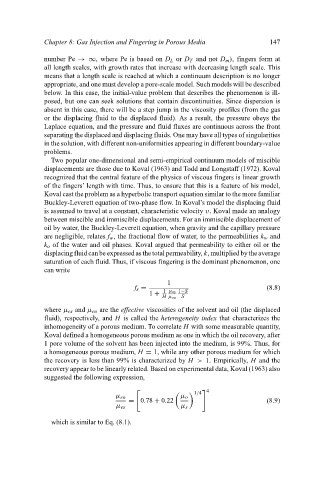
                           where µ es and µ eo are the effective viscosities of the solvent and oil (the displaced
                           fluid), respectively, and H is called the heterogeneity index that characterizes the
                           inhomogeneity of a porous medium. To correlate H with some measurable quantity,
                           Koval defined a homogeneous porous medium as one in which the oil recovery, after
                           1 pore volume of the solvent has been injected into the medium, is 99%. Thus, for
                           a homogeneous porous medium, H = 1, while any other porous medium for which
                           the recovery is less than 99% is characterized by H > 1. Empirically, H and the
                           recovery appear to be linearly related. Based on experimental data, Koval (1963) also
                           suggested the following expression,
                                                                          4
                                                                    	 1/4
                                               µ eo               µ o
                                                   = 0.78 + 0.22                          (8.9)
                                                µ es              µ s
                             which is similar to Eq. (8.1).

