


Page 158 - gas transport in porous media
P. 158
151
                           Chapter 8: Gas Injection and Fingering in Porous Media
                           Batycky, 1997) relies on the consistency of treating the convective flux independently
                           of gravity flux within a given time step of the simulation. For small time steps, the
                           operator-splitting approximation is fairly accurate, whereas large time steps may
                           lead to significant errors. Jessen and Orr (2004) used the operator-splitting tech-
                           nique to develop a compositional simulator suitable for displacement processes with
                           significant gravity segregation.
                           8.7.4  Spectral Methods

                           To overcome the limitation in the accuracy of many of the above grid-based methods,
                           significantly more accurate spectral methods have also been developed (see, e.g.,
                           Tan and Homsy, 1988; Zimmerman and Homsy, 1992a,b; Rogerson and Meiburg,
                           1993a,b). These methods possess superior accuracy for smooth flows, that is, for
                           flows without discontinuities and singularities (Gottlieb and Orszag, 1977), and avoid
                           problems associated with numerical diffusion. In addition, the spectral simulations
                           are carried out for the governing equations that are formulated in terms of the vorticity
                           and the stream functions. Since one no longer needs to solve for the pressure distribu-
                           tion, such formulation of the governing equations often leads to higher computational
                           efficiency. Moreover, this formulation offers the advantage that it satisfies the con-
                           servation of mass identically. Thus, these methods allow for detailed investigation
                           of mobility- and gravity-driven fingering processes in rectilinear displacements at
                           relatively low levels of physical dispersion.

                           8.8  STOCHASTIC MODELS OF MISCIBLE DISPLACEMENTS

                           In addition to the above methods, several models of miscible displacement pro-
                           cesses in porous media, for both the laboratory and field-scale porous media, have
                           been developed in which probabilistic concepts have been utilized. Many of such
                           models (DeGregoria, 1985; Paterson, 1984; Sherwood and Nittman, 1986; Siddiqui
                           and Sahimi, 1990a,b) are applicable when the effect of dispersion can be neglected.
                           We describe briefly two stochastic models that do take into account the effect of
                           dispersion.
                             The first model that we describe is due to King and Scher (1987, 1990). Consider
                           first the case of miscible displacements without dispersion. For point injection of
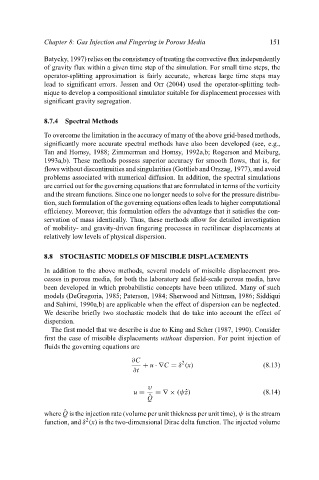
                           fluids the governing equations are

                                                    ∂C            2
                                                       + u ·∇C = δ (x)                   (8.13)
                                                    ∂t
                                                         υ
                                                     u =   =∇ × (ψˆz)                    (8.14)
                                                        Q
                                                         ˆ
                           where Q is the injection rate (volume per unit thickness per unit time), ψ is the stream
                                 ˆ
                                       2
                           function, and δ (x) is the two-dimensional Dirac delta function. The injected volume

