


Page 162 - gas transport in porous media
P. 162
155
                           Chapter 8: Gas Injection and Fingering in Porous Media
                           radial Hele-Shaw Cell (Kopf-Sill and Homsy, 1988; Meiburg and Homsy, 1988). At
                           the same time, explanation of fingering in Hele-Shaw cells is typically based on the
                           assumption of the presence of a perturbation in the system. Moreover, some studies
                           (Christie and Bond, 1987; Fanchi and Christianson, 1989; Fanchi, 1990) suggest that
                           non-linear dynamics of a miscible displacement may provide an alternative source
                           for the disturbances in porous media.
                             Kelkar and Gupta (1988) reported that they were unable to initiate a finger with-
                           out introducing some type of perturbation, such as a permeability variation or a
                           concentration perturbation. As described above, Araktingi and Orr (1990) intro-
                           duced randomness in their model. These works illustrate the approach taken by
                           many researchers in the field: Identify a parameter in the system with values that
                           exhibit some degree of spatial randomness. The randomness then becomes the source
                           of the perturbation. A problem with this approach is its dependence on the ad hoc
                           incorporation of a probabilistically-distributed variable.
                             We now provide a more quantitative discussion of stability analysis of miscible
                           displacements. The main goals of this discussion are to illustrate, (i) how a stability
                           analysis is actually carried out, and (ii) how far such an analysis can take one.
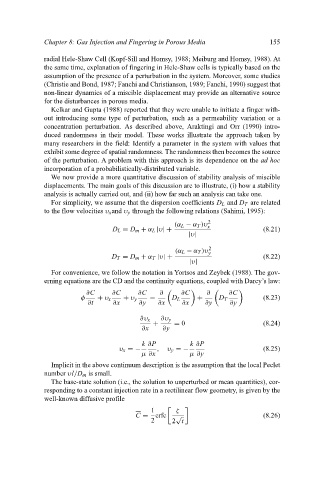
                             For simplicity, we assume that the dispersion coefficients D L and D T are related
                           to the flow velocities υ x and υ y through the following relations (Sahimi, 1995):

                                                                (α L − α T )υ x 2
                                               D L = D m + α L |υ| +                     (8.21)
                                                                    |υ|
                                                                (α L − α T )υ y 2
                                              D T = D m + α T |υ| +                      (8.22)
                                                                    |υ|
                             For convenience, we follow the notation in Yortsos and Zeybek (1988). The gov-
                           erning equations are the CD and the continuity equations, coupled with Darcy’s law:

                                       ∂C     ∂C      ∂C    ∂     ∂C     ∂      ∂C
                                      φ   + υ x   + υ y  =     D L     +     D T         (8.23)
                                       ∂t      ∂x     ∂y   ∂x     ∂x     ∂y     ∂y

                                                      ∂υ x  ∂υ y
                                                          +     = 0                      (8.24)
                                                       ∂x    ∂y
                                                       k ∂P          k ∂P
                                                υ x =−     ,  υ y =−                     (8.25)
                                                       µ ∂x         µ ∂y
                             Implicit in the above continuum description is the assumption that the local Peclet
                           number υl/D m is small.
                             The base-state solution (i.e., the solution to unperturbed or mean quantities), cor-
                           responding to a constant injection rate in a rectilinear flow geometry, is given by the
                           well-known diffusive profile

                                                         1       ζ
                                                     C =   erfc  √                       (8.26)
                                                         2     2 t

