


Page 161 - gas transport in porous media
P. 161
154
                                            0.8                                     Sahimi et al.


                                          Recovery

                                            0.4


                                             0
                                                      0.4      0.8      1.2
                                                         Pore volume injected

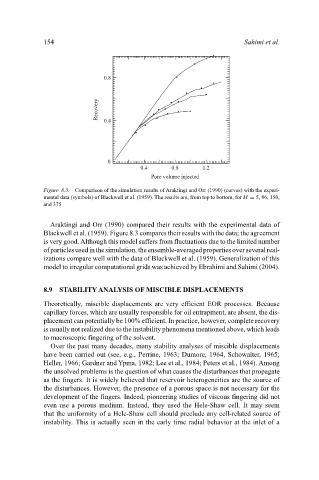
                           Figure 8.3.  Comparison of the simulation results of Araktingi and Orr (1990) (curves) with the experi-
                           mental data (symbols) of Blackwell et al. (1959). The results are, from top to bottom, for M = 5, 86, 150,
                           and 375


                             Araktingi and Orr (1990) compared their results with the experimental data of
                           Blackwell et al. (1959). Figure 8.3 compares their results with the data; the agreement
                           is very good. Although this model suffers from fluctuations due to the limited number
                           of particles used in the simulation, the ensemble-averaged properties over several real-
                           izations compare well with the data of Blackwell et al. (1959). Generalization of this
                           model to irregular computational grids was achieved by Ebrahimi and Sahimi (2004).


                           8.9  STABILITY ANALYSIS OF MISCIBLE DISPLACEMENTS

                           Theoretically, miscible displacements are very efficient EOR processes. Because
                           capillary forces, which are usually responsible for oil entrapment, are absent, the dis-
                           placement can potentially be 100% efficient. In practice, however, complete recovery
                           is usually not realized due to the instability phenomena mentioned above, which leads
                           to macroscopic fingering of the solvent.
                             Over the past many decades, many stability analyses of miscible displacements
                           have been carried out (see, e.g., Perrine, 1963; Dumore, 1964, Schowalter, 1965;
                           Heller, 1966; Gardner and Ypma, 1982; Lee et al., 1984; Peters et al., 1984). Among
                           the unsolved problems is the question of what causes the disturbances that propagate
                           as the fingers. It is widely believed that reservoir heterogeneities are the source of
                           the disturbances. However, the presence of a porous space is not necessary for the
                           development of the fingers. Indeed, pioneering studies of viscous fingering did not
                           even use a porous medium. Instead, they used the Hele-Shaw cell. It may seem
                           that the uniformity of a Hele-Shaw cell should preclude any cell-related source of
                           instability. This is actually seen in the early time radial behavior at the inlet of a

