


Page 165 - gas transport in porous media
P. 165
158
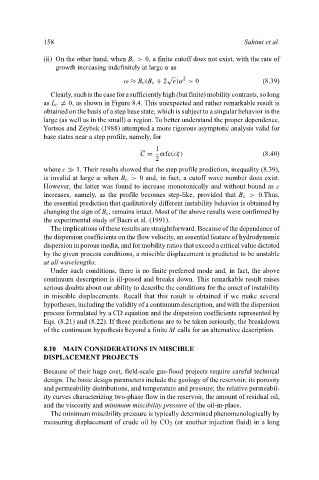
                           (ii) On the other hand, when B c > 0, a finite cutoff does not exist, with the rate of
                              growth increasing indefinitely at large α as          Sahimi et al.
                                                              √
                                                                   2
                                                  ω ≈ B c (B c + 2 ε)α > 0               (8.39)
                             Clearly, such is the case for a sufficiently high (but finite) mobility contrasts, so long
                           as L c  = 0, as shown in Figure 8.4. This unexpected and rather remarkable result is
                           obtained on the basis of a step base state, which is subject to a singular behavior in the
                           large (as well as in the small) α region. To better understand the proper dependence,
                           Yortsos and Zeybek (1988) attempted a more rigorous asymptotic analysis valid for
                           base states near a step profile, namely, for
                                                           1
                                                      C =   erfc(cξ)                     (8.40)
                                                           2
                           where c   1. Their results showed that the step profile prediction, inequality (8.39),
                           is invalid at large α when B c > 0 and, in fact, a cutoff wave number does exist.
                           However, the latter was found to increase monotonically and without bound as c
                           increases, namely, as the profile becomes step-like, provided that B c > 0.Thus,
                           the essential prediction that qualitatively different instability behavior is obtained by
                           changing the sign of B c , remains intact. Most of the above results were confirmed by
                           the experimental study of Bacri et al. (1991).
                             The implications of these results are straightforward. Because of the dependence of
                           the dispersion coefficients on the flow velocity, an essential feature of hydrodynamic
                           dispersion in porous media, and for mobility ratios that exceed a critical value dictated
                           by the given process conditions, a miscible displacement is predicted to be unstable
                           at all wavelengths.
                             Under such conditions, there is no finite preferred mode and, in fact, the above
                           continuum description is ill-posed and breaks down. This remarkable result raises
                           serious doubts about our ability to describe the conditions for the onset of instability
                           in miscible displacements. Recall that this result is obtained if we make several
                           hypotheses, including the validity of a continuum description, and with the dispersion
                           process formulated by a CD equation and the dispersion coefficients represented by
                           Eqs. (8.21) and (8.22). If these predictions are to be taken seriously, the breakdown
                           of the continuum hypothesis beyond a finite M calls for an alternative description.


                           8.10  MAIN CONSIDERATIONS IN MISCIBLE
                           DISPLACEMENT PROJECTS

                           Because of their huge cost, field-scale gas-flood projects require careful technical
                           design. The basic design parameters include the geology of the reservoir; its porosity
                           and permeability distributions, and temperature and pressure; the relative permeabil-
                           ity curves characterizing two-phase flow in the reservoir, the amount of residual oil,
                           and the viscosity and minimum miscibility pressure of the oil-in-place.
                             The minimum miscibility pressure is typically determined phenomenologically by
                           measuring displacement of crude oil by CO 2 (or another injection fluid) in a long

