


Page 159 - gas transport in porous media
P. 159
152
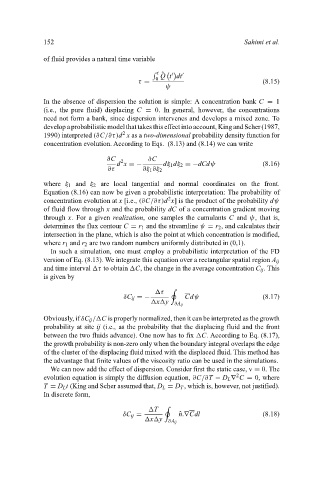
                           of fluid provides a natural time variable
                                                           t  ˆ
                                                          7                         Sahimi et al.
                                                           0  Q t dt
                                                      τ =                                (8.15)
                                                              ψ
                           In the absence of dispersion the solution is simple: A concentration bank C = 1
                           (i.e., the pure fluid) displacing C = 0. In general, however, the concentrations
                           need not form a bank, since dispersion intervenes and develops a mixed zone. To
                           develop a probabilistic model that takes this effect into account, King and Scher (1987,
                                                 2
                           1990) interpreted (∂C/∂τ)d x as a two-dimensional probability density function for
                           concentration evolution. According to Eqs. (8.13) and (8.14) we can write
                                             ∂C  2       ∂C
                                                d x =−       dξ 1 dξ 2 =−dCdψ            (8.16)
                                             ∂τ        ∂ξ 1 ∂ξ 2
                           where ξ 1 and ξ 2 are local tangential and normal coordinates on the front.
                           Equation (8.16) can now be given a probabilistic interpretation: The probability of
                                                              2
                           concentration evolution at x [i.e., (∂C/∂τ)d x] is the product of the probability dψ
                           of fluid flow through x and the probability dC of a concentration gradient moving
                           through x. For a given realization, one samples the cumulants C and ψ, that is,
                           determines the flux contour C = r 1 and the streamline ψ = r 2 , and calculates their
                           intersection in the plane, which is also the point at which concentration is modified,
                           where r 1 and r 2 are two random numbers uniformly distributed in (0,1).
                             In such a simulation, one must employ a probabilistic interpretation of the FD
                           version of Eq. (8.13). We integrate this equation over a rectangular spatial region A ij
                           and time interval  τ to obtain  C, the change in the average concentration C ij . This
                           is given by
                                                            τ  8
                                                  δC ij =−         Cdψ                   (8.17)
                                                          x y
                                                                ∂A ij
                           Obviously, if δC ij / C is properly normalized, then it can be interpreted as the growth
                           probability at site ij (i.e., as the probability that the displacing fluid and the front
                           between the two fluids advance). One now has to fix  C. According to Eq. (8.17),
                           the growth probability is non-zero only when the boundary integral overlaps the edge
                           of the cluster of the displacing fluid mixed with the displaced fluid. This method has
                           the advantage that finite values of the viscosity ratio can be used in the simulations.
                             We can now add the effect of dispersion. Consider first the static case, v = 0. The
                                                                                  2
                           evolution equation is simply the diffusion equation, ∂C/∂T − D L ∇ C = 0, where
                           T = D L t (King and Scher assumed that, D L = D T , which is, however, not justified).
                           In discrete form,
                                                          T  8
                                                 δC ij =         ˆ n.∇Cdl                (8.18)
                                                         x y
                                                              ∂A ij

