


Page 207 - gas transport in porous media
P. 207
202
                           dependent flow/transport processes (e.g., hydrodynamic dispersion is superceded by
                           macrodispersion at larger length scales).                    Tidwell
                             Below we briefly consider the role of scaling in the modeling of fluid flow and
                           mass transport in porous and fractured media. We begin by reviewing some basic
                           approaches to modeling material property scaling. We then present examples from
                           the laboratory and field demonstrating scaling effects. The focus of this section is on
                           the scaling of permeability and dispersivity.


                           11.1  SCALING THEORIES
                           Simple averaging rules (arithmetic, geometric, and harmonic) represent the point of
                           entry for classical scaling theory. These averaging rules are only valid for a narrow
                           range of aquifer/reservoir conditions. Specifically, an infinitely stratified formation
                           comprised of individual layers with constant permeability that is subject to steady, lin-
                           ear flow. Where flow is oriented parallel to the stratification the effective permeability
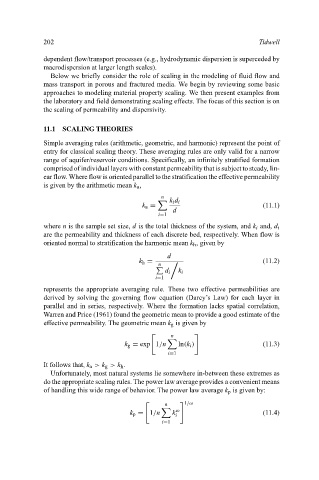
                           is given by the arithmetic mean k a ,
                                                            n

                                                               k i d i
                                                       k a =                             (11.1)
                                                                d
                                                            i=1
                           where n is the sample set size, d is the total thickness of the system, and k i and, d i
                           are the permeability and thickness of each discrete bed, respectively. When flow is
                           oriented normal to stratification the harmonic mean k h , given by
                                                              d
                                                      k h =    :                         (11.2)
                                                            n
                                                           6
                                                             d i  k i
                                                           i=1
                           represents the appropriate averaging rule. These two effective permeabilities are
                           derived by solving the governing flow equation (Darcy’s Law) for each layer in
                           parallel and in series, respectively. Where the formation lacks spatial correlation,
                           Warren and Price (1961) found the geometric mean to provide a good estimate of the
                           effective permeability. The geometric mean k g is given by

                                                               n

                                                  k g = exp 1/n  ln(k i )                (11.3)
                                                              i=1
                           It follows that, k a > k g > k h .
                             Unfortunately, most natural systems lie somewhere in-between these extremes as
                           do the appropriate scaling rules. The power law average provides a convenient means
                           of handling this wide range of behavior. The power law average k p is given by:
                                                                    1/ω
                                                             n
                                                                 ω
                                                   k p = 1/n   k                         (11.4)
                                                                i
                                                             i=1

