


Page 208 - gas transport in porous media
P. 208
203
                           Chapter 11: Scaling Issues in Porous and Fractured Media
                           where ω is the power coefficient. With this approach the selection of an appropriate
                           scaling rule is predicated on finding the proper power coefficient. Where flow is
                           oriented parallel or normal to an infinitely stratified system ω is simply set to 1
                           or −1 to yield an arithmetic or harmonic average, respectively. Alternatively, the
                           geometric mean is defined as ω = 0, and thus Equation (11.4) must undergo a limited
                           expansion as currently defined. In general, empirical methods are used to determine
                           ω. Journel et al. (1986) and Deutsch (1989) provide algorithms for estimating ω for
                           bimodal sand-shale sequences, while Desbarats (1992b) provides direction in the case
                           of log-normally distributed data.
                             Stochastic methods (e.g., Bakr et al., 1978; Gelhar, 1993) have been developed that
                           allow direct calculation of effective properties based on the heterogeneous character-
                           istics of the aquifer/reservoir. Application of these methods requires an unbounded
                           domain, and uniform flow (i.e., the extent of the domain and the characteristic scale
                           of the flow nonuniformity are much larger than the correlation length scale of the
                           medium). The permeability distribution must also be a weakly stationary and ergodic
                           random variable with a relatively small variance (generally Var[lnk] < 1, how-
                           ever under certain circumstances this limit can be exceeded). In this approach, the
                           aquifer/reservoir is viewed as an ensemble of homogenous, isotropic blocks whose
                           spatial distribution is fully characterized by its first two moments. Using a small per-
                           turbation, first-order approximation of the governing stochastic differential equation,
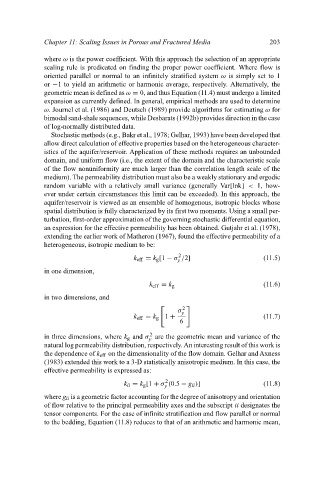
                           an expression for the effective permeability has been obtained. Gutjahr et al. (1978),
                           extending the earlier work of Matheron (1967), found the effective permeability of a
                           heterogeneous, isotropic medium to be:
                                                                 2
                                                     k eff = k g [1 − σ /2]              (11.5)
                                                                 y
                           in one dimension,

                                                         k eff = k g                     (11.6)
                           in two dimensions, and
                                                                  2
                                                                 σ
                                                                  y
                                                     k eff = k g 1 +                     (11.7)
                                                                  6
                                                         2
                           in three dimensions, where k g and σ are the geometric mean and variance of the
                                                         y
                           natural log permeability distribution, respectively.An interesting result of this work is
                           the dependence of k eff on the dimensionality of the flow domain. Gelhar and Axness
                           (1983) extended this work to a 3-D statistically anisotropic medium. In this case, the
                           effective permeability is expressed as:
                                                              2
                                                  k ii = k g [1 + σ (0.5 − g ii )]       (11.8)
                                                             y
                           where g ii is a geometric factor accounting for the degree of anisotropy and orientation
                           of flow relative to the principal permeability axes and the subscript ii designates the
                           tensor components. For the case of infinite stratification and flow parallel or normal
                           to the bedding, Equation (11.8) reduces to that of an arithmetic and harmonic mean,

