


Page 209 - gas transport in porous media
P. 209
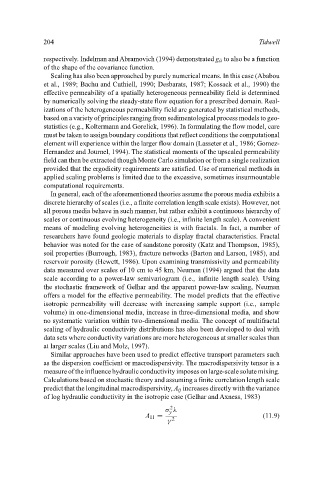
204
                           respectively. Indelman andAbramovich (1994) demonstrated g ii to also be a function
                           of the shape of the covariance function.                     Tidwell
                             Scaling has also been approached by purely numerical means. In this case (Ababou
                           et al., 1989; Bachu and Cuthiell, 1990; Desbarats, 1987; Kossack et al., 1990) the
                           effective permeability of a spatially heterogeneous permeability field is determined
                           by numerically solving the steady-state flow equation for a prescribed domain. Real-
                           izations of the heterogeneous permeability field are generated by statistical methods,
                           based on a variety of principles ranging from sedimentological process models to geo-
                           statistics (e.g., Koltermann and Gorelick, 1996). In formulating the flow model, care
                           must be taken to assign boundary conditions that reflect conditions the computational
                           element will experience within the larger flow domain (Lasseter et al., 1986; Gomez-
                           Hernandez and Journel, 1994). The statistical moments of the upscaled permeability
                           field can then be extracted though Monte Carlo simulation or from a single realization
                           provided that the ergodicity requirements are satisfied. Use of numerical methods in
                           applied scaling problems is limited due to the excessive, sometimes insurmountable
                           computational requirements.
                             In general, each of the aforementioned theories assume the porous media exhibits a
                           discrete hierarchy of scales (i.e., a finite correlation length scale exists). However, not
                           all porous media behave in such manner, but rather exhibit a continuous hierarchy of
                           scales or continuous evolving heterogeneity (i.e., infinite length scale). A convenient
                           means of modeling evolving heterogeneities is with fractals. In fact, a number of
                           researchers have found geologic materials to display fractal characteristics. Fractal
                           behavior was noted for the case of sandstone porosity (Katz and Thompson, 1985),
                           soil properties (Burrough, 1983), fracture networks (Barton and Larson, 1985), and
                           reservoir porosity (Hewett, 1986). Upon examining transmissivity and permeability
                           data measured over scales of 10 cm to 45 km, Neuman (1994) argued that the data
                           scale according to a power-law semivariogram (i.e., infinite length scale). Using
                           the stochastic framework of Gelhar and the apparent power-law scaling, Neuman
                           offers a model for the effective permeability. The model predicts that the effective
                           isotropic permeability will decrease with increasing sample support (i.e., sample
                           volume) in one-dimensional media, increase in three-dimensional media, and show
                           no systematic variation within two-dimensional media. The concept of multifractal
                           scaling of hydraulic conductivity distributions has also been developed to deal with
                           data sets where conductivity variations are more heterogeneous at smaller scales than
                           at larger scales (Liu and Molz, 1997).
                             Similar approaches have been used to predict effective transport parameters such
                           as the dispersion coefficient or macrodispersivity. The macrodispersivity tensor is a
                           measure of the influence hydraulic conductivity imposes on large-scale solute mixing.
                           Calculations based on stochastic theory and assuming a finite correlation length scale
                           predict that the longitudinal macrodispersivity, A ij increases directly with the variance
                           of log hydraulic conductivity in the isotropic case (Gelhar and Axness, 1983)
                                                               2
                                                              σ λ
                                                               y
                                                        A 11 =                           (11.9)
                                                              γ  2

