


Page 219 - gas transport in porous media
P. 219
Chapter 12: Continuum Modeling of Gas Transport in Porous Media
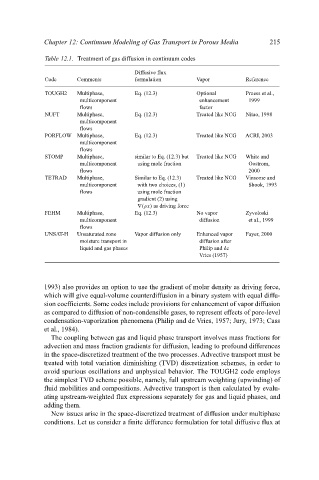
                           Table 12.1. Treatment of gas diffusion in continuum codes
                                                     Diffusive flux                        215
                           Code     Comments         formulation      Vapor         Reference
                           TOUGH2   Multiphase,      Eq. (12.3)       Optional      Pruess et al.,
                                     multicomponent                    enhancement   1999
                                     flows                             factor
                           NUFT     Multiphase,      Eq. (12.3)       Treated like NCG  Nitao, 1998
                                     multicomponent
                                     flows
                           PORFLOW Multiphase,       Eq. (12.3)       Treated like NCG  ACRI, 2003
                                     multicomponent
                                     flows
                           STOMP    Multiphase,      similar to Eq. (12.3) but  Treated like NCG  White and
                                     multicomponent   using mole fraction            Oostrom,
                                     flows                                           2000
                           TETRAD   Multiphase,      Similar to Eq. (12.3)  Treated like NCG  Vinsome and
                                     multicomponent   with two choices, (1)          Shook, 1993
                                     flows            using mole fraction
                                                      gradient (2) using
                                                      ∇(ρx) as driving force
                           FEHM     Multiphase,      Eq. (12.3)       No vapor      Zyvoloski
                                     multicomponent                    diffusion     et al., 1999
                                     flows
                           UNSAT-H  Unsaturated zone  Vapor diffusion only  Enhanced vapor  Fayer, 2000
                                     moisture transport in             diffusion after
                                     liquid and gas phases             Philip and de
                                                                       Vries (1957)


                           1993) also provides an option to use the gradient of molar density as driving force,
                           which will give equal-volume counterdiffusion in a binary system with equal diffu-
                           sion coefficients. Some codes include provisions for enhancement of vapor diffusion
                           as compared to diffusion of non-condensible gases, to represent effects of pore-level
                           condensation-vaporization phenomena (Philip and de Vries, 1957; Jury, 1973; Cass
                           et al., 1984).
                             The coupling between gas and liquid phase transport involves mass fractions for
                           advection and mass fraction gradients for diffusion, leading to profound differences
                           in the space-discretized treatment of the two processes. Advective transport must be
                           treated with total variation diminishing (TVD) discretization schemes, in order to
                           avoid spurious oscillations and unphysical behavior. The TOUGH2 code employs
                           the simplest TVD scheme possible, namely, full upstream weighting (upwinding) of
                           fluid mobilities and compositions. Advective transport is then calculated by evalu-
                           ating upstream-weighted flux expressions separately for gas and liquid phases, and
                           adding them.
                             New issues arise in the space-discretized treatment of diffusion under multiphase
                           conditions. Let us consider a finite difference formulation for total diffusive flux at

