


Page 221 - gas transport in porous media
P. 221
Chapter 12: Continuum Modeling of Gas Transport in Porous Media
                                                   M   M    M    M                         217
                                                F    F    F    F
                                                                                    Fractures
                                                   M   M    M    M                  Matrix  Blocks
                                                F    F    F    F
                                                   M   M    M    M
                                                F    F    F    F
                                                   M   M    M    M
                                                F    F    F    F
                                 (a)                                       (c)
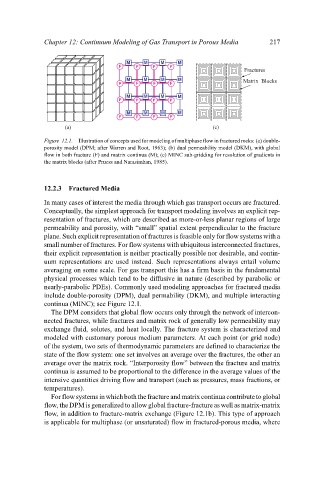
                           Figure 12.1.  Illustration of concepts used for modeling of multiphase flow in fractured rocks: (a) double-
                           porosity model (DPM; after Warren and Root, 1963); (b) dual permeability model (DKM), with global
                           flow in both fracture (F) and matrix continua (M); (c) MINC sub-gridding for resolution of gradients in
                           the matrix blocks (after Pruess and Narasimhan, 1985).


                           12.2.3  Fractured Media

                           In many cases of interest the media through which gas transport occurs are fractured.
                           Conceptually, the simplest approach for transport modeling involves an explicit rep-
                           resentation of fractures, which are described as more-or-less planar regions of large
                           permeability and porosity, with “small” spatial extent perpendicular to the fracture
                           plane. Such explicit representation of fractures is feasible only for flow systems with a
                           small number of fractures. For flow systems with ubiquitous interconnected fractures,
                           their explicit representation is neither practically possible nor desirable, and contin-
                           uum representations are used instead. Such representations always entail volume
                           averaging on some scale. For gas transport this has a firm basis in the fundamental
                           physical processes which tend to be diffusive in nature (described by parabolic or
                           nearly-parabolic PDEs). Commonly used modeling approaches for fractured media
                           include double-porosity (DPM), dual permability (DKM), and multiple interacting
                           continua (MINC); see Figure 12.1.
                             The DPM considers that global flow occurs only through the network of intercon-
                           nected fractures, while fractures and matrix rock of generally low permeability may
                           exchange fluid, solutes, and heat locally. The fracture system is characterized and
                           modeled with customary porous medium parameters. At each point (or grid node)
                           of the system, two sets of thermodynamic parameters are defined to characterize the
                           state of the flow system: one set involves an average over the fractures, the other an
                           average over the matrix rock. “Interporosity flow” between the fracture and matrix
                           continua is assumed to be proportional to the difference in the average values of the
                           intensive quantities driving flow and transport (such as pressures, mass fractions, or
                           temperatures).
                             For flow systems in which both the fracture and matrix continua contribute to global
                           flow, the DPM is generalized to allow global fracture-fracture as well as matrix-matrix
                           flow, in addition to fracture-matrix exchange (Figure 12.1b). This type of approach
                           is applicable for multiphase (or unsaturated) flow in fractured-porous media, where

