


Page 222 - gas transport in porous media
P. 222
218
                           global flow of the gas phase may occur through the fracture network, while global
                           flow of the aqueous (wetting) phase may involve matrix-to-matrix flow.  Pruess
                             The DPM implies a quasi-steady approximation for interporosity flow. In some
                           cases the characteristic times for interporosity flow and transport may be large, and the
                           quasi-steady approximation becomes inaccurate. Under these circumstances it may
                           be necessary to resolve the gradients driving fracture-matrix exchange, which can
                           be accomplished by sub-gridding of matrix blocks into a series of continua defined
                           according to distance from the matrix block surface, the so-called MINC-concept
                           (Figure 12.1c).


                           12.2.4  Example: Diffusive Effects in the Migration of
                           Volatile Tracers in Fractured Media
                           Tracer testing has been extensively applied in fractured geothermal reservoirs as a
                           means for mapping fast preferential pathways and characterizing reservoir processes
                           that involve boiling and condensation phenomena. Diffusive propagation of tracers
                           tends to be slow in comparison to advective transport, so that its contribution to
                           transport over interwell distances is negligible. However, diffusion can be a very
                           important process for fracture-matrix exchange, and as such can have a strong influ-
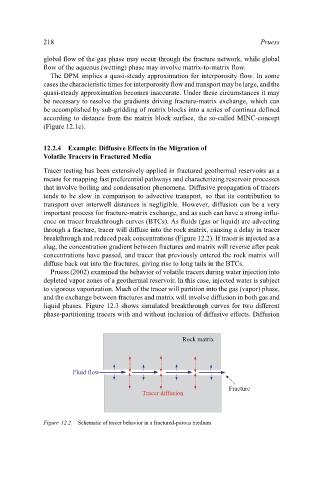
                           ence on tracer breakthrough curves (BTCs). As fluids (gas or liquid) are advecting
                           through a fracture, tracer will diffuse into the rock matrix, causing a delay in tracer
                           breakthrough and reduced peak concentrations (Figure 12.2). If tracer is injected as a
                           slug, the concentration gradient between fractures and matrix will reverse after peak
                           concentrations have passed, and tracer that previously entered the rock matrix will
                           diffuse back out into the fractures, giving rise to long tails in the BTCs.
                             Pruess (2002) examined the behavior of volatile tracers during water injection into
                           depleted vapor zones of a geothermal reservoir. In this case, injected water is subject
                           to vigorous vaporization. Much of the tracer will partition into the gas (vapor) phase,
                           and the exchange between fractures and matrix will involve diffusion in both gas and
                           liquid phases. Figure 12.3 shows simulated breakthrough curves for two different
                           phase-partitioning tracers with and without inclusion of diffusive effects. Diffusion


                                                                  Rock matrix


                                   Fluid flow

                                                                                Fracture
                                                       Tracer diffusion


                           Figure 12.2.  Schematic of tracer behavior in a fractured-porous medium

