


Page 227 - gas transport in porous media
P. 227
Chapter 13: Lattice Boltzmann Method
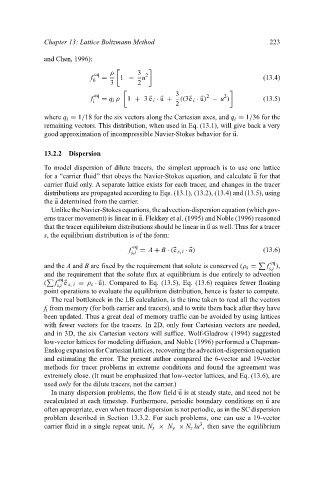
                           and Chen, 1996):
                                                                                           223
                                         eq   ρ       3  2
                                        f  =     1 −   u                                 (13.4)
                                         0
                                              3       2

                                         eq                     3        2    2
                                                         e
                                        f i  = q i ρ  1 + 3   i · u +  ((3  i · u) − u )  (13.5)
                                                                    e
                                                                2
                           where q i = 1/18 for the six vectors along the Cartesian axes, and q i = 1/36 for the
                           remaining vectors. This distribution, when used in Eq. (13.1), will give back a very
                           good approximation of incompressible Navier-Stokes behavior for  u.
                           13.2.2  Dispersion
                           To model dispersion of dilute tracers, the simplest approach is to use one lattice
                           for a “carrier fluid” that obeys the Navier-Stokes equation, and calculate  u for that
                           carrier fluid only. A separate lattice exists for each tracer, and changes in the tracer
                           distributions are propagated according to Eqs. (13.1), (13.2), (13.4) and (13.5), using
                           the  u determined from the carrier.
                             Unlike the Navier-Stokes equations, the advection-dispersion equation (which gov-
                           erns tracer movement) is linear in  u. Flekkøy et al. (1995) and Noble (1996) reasoned
                           that the tracer equilibrium distributions should be linear in  u as well. Thus for a tracer
                           s, the equilibrium distribution is of the form:

                                                    eq
                                                                e
                                                   f s,i  = A + B · (  s, i · u)         (13.6)
                                                                                        6  eq
                           and the A and B are fixed by the requirement that solute is conserved (ρ s =  f ),
                                                                                           s,i
                           and the requirement that the solute flux at equilibrium is due entirely to advection
                            6  eq
                           (  f  e s, i = ρ s · u). Compared to Eq. (13.5), Eq. (13.6) requires fewer floating
                               s,i
                           point operations to evaluate the equilibrium distribution, hence is faster to compute.
                             The real bottleneck in the LB calculation, is the time taken to read all the vectors
                           f i from memory (for both carrier and tracers), and to write them back after they have
                           been updated. Thus a great deal of memory traffic can be avoided by using lattices
                           with fewer vectors for the tracers. In 2D, only four Cartesian vectors are needed,
                           and in 3D, the six Cartesian vectors will suffice. Wolf-Gladrow (1994) suggested
                           low-vector lattices for modeling diffusion, and Noble (1996) performed a Chapman-
                           Enskog expansion for Cartesian lattices, recovering the advection-dispersion equation
                           and estimating the error. The present author compared the 6-vector and 19-vector
                           methods for tracer problems in extreme conditions and found the agreement was
                           extremely close. (It must be emphasized that low-vector lattices, and Eq. (13.6), are
                           used only for the dilute tracers, not the carrier.)
                             In many dispersion problems, the flow field  u is at steady state, and need not be
                           recalculated at each timestep. Furthermore, periodic boundary conditions on  u are
                           often appropriate, even when tracer dispersion is not periodic, as in the SC dispersion
                           problem described in Section 13.3.2. For such problems, one can use a 19-vector
                                                                       3
                           carrier fluid in a single repeat unit, N x × N y × N z lu , then save the equilibrium

