


Page 228 - gas transport in porous media
P. 228
Stockman
                           224
                                                                              2
                             u(x, y, z). Typically, the flow reaches steady-state at time > L /ν, where ν is the
                           kinematic viscosity of the carrier fluid, and L is a characteristic length scale perpen-
                           dicular to the flow direction (e.g., the channel width). Then the memory used for the
                           19-vector carrier fluid can be reclaimed, and reallocated for additional repeat units of
                           solid geometry (and the lattice used for the tracers) in the x direction. The velocity field
                           at x, y, z is then  u((x MOD N x ), y, z). The lattice Boltzmann updates for the tracers
                           are still carried out at each step, but rather than recalculate the velocity at each point,
                           the saved velocity field is used. We refer to these additional repeat units as “clones.”
                             As mentioned, the viscosity of the carrier fluid, and the diffusion coefficients of
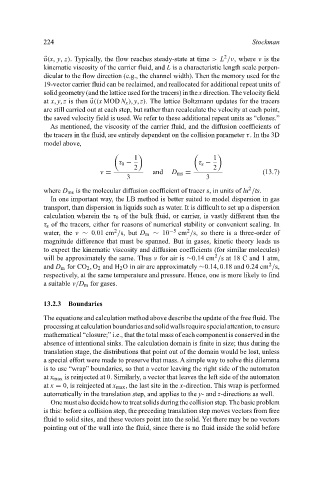
                           the tracers in the fluid, are entirely dependent on the collision parameter τ. In the 3D
                           model above,


                                                     1                     1
                                                τ 0 −                  τ s −
                                                     2                     2
                                           ν =            and  D ms =                    (13.7)
                                                   3                     3
                                                                                     2
                           where D ms is the molecular diffusion coefficient of tracer s, in units of lu /ts.
                             In one important way, the LB method is better suited to model dispersion in gas
                           transport, than dispersion in liquids such as water. It is difficult to set up a dispersion
                           calculation wherein the τ 0 of the bulk fluid, or carrier, is vastly different than the
                           τ s of the tracers, either for reasons of numerical stability or convenient scaling. In
                                               2
                                                                    2
                           water, the ν ∼ 0.01 cm /s, but D m ∼ 10 −5  cm /s, so there is a three-order of
                           magnitude difference that must be spanned. But in gases, kinetic theory leads us
                           to expect the kinematic viscosity and diffusion coefficients (for similar molecules)
                                                                            2
                           will be approximately the same. Thus ν for air is ∼0.14 cm /s at 18 C and 1 atm,
                                                                                           2
                           and D m for CO 2 ,O 2 and H 2 O in air are approximately ∼0.14, 0.18 and 0.24 cm /s,
                           respectively, at the same temperature and pressure. Hence, one is more likely to find
                           a suitable ν/D m for gases.

                           13.2.3  Boundaries
                           The equations and calculation method above describe the update of the free fluid. The
                           processingatcalculationboundariesandsolidwallsrequirespecialattention, toensure
                           mathematical “closure;” i.e., that the total mass of each component is conserved in the
                           absence of intentional sinks. The calculation domain is finite in size; thus during the
                           translation stage, the distributions that point out of the domain would be lost, unless
                           a special effort were made to preserve that mass. A simple way to solve this dilemma
                           is to use “wrap” boundaries, so that a vector leaving the right side of the automaton
                           at x max is reinjected at 0. Similarly, a vector that leaves the left side of the automaton
                           at x = 0, is reinjected at x max , the last site in the x-direction. This wrap is performed
                           automatically in the translation step, and applies to the y- and z-directions as well.
                             Onemustalsodecidehowtotreatsolidsduringthecollisionstep. Thebasicproblem
                           is this: before a collision step, the preceding translation step moves vectors from free
                           fluid to solid sites, and these vectors point into the solid. Yet there may be no vectors
                           pointing out of the wall into the fluid, since there is no fluid inside the solid before

