


Page 229 - gas transport in porous media
P. 229
225
                           Chapter 13: Lattice Boltzmann Method
                           translation. A simple solution is to invert the directions of all vectors on the wall
                           (for both the carrier fluid and each tracer); this approach is called the “bounce-back”
                           boundary, and it assures that there is a no-slip velocity boundary near the wall (Chen
                           etal., 1996). Section13.4willdiscusstheconsequencesofbounce-backinmoredetail.
                             If a solid boundary is placed at the ends of the automaton, it automatically
                           supercedes the wrap condition, because the solid wall deflects all outward-pointing
                           vectors back into the automaton.
                            Self Study Example:
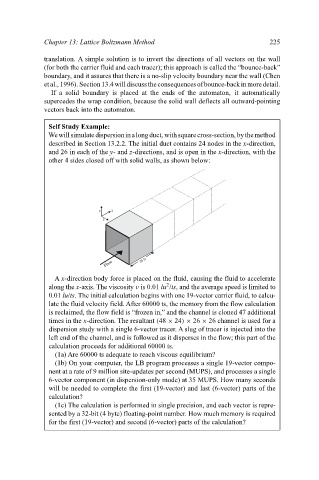
                            Wewillsimulatedispersioninalongduct, withsquarecross-section, bythemethod
                            described in Section 13.2.2. The initial duct contains 24 nodes in the x-direction,
                            and 26 in each of the y- and z-directions, and is open in the x-direction, with the
                            other 4 sides closed off with solid walls, as shown below:


                                           y  x
                                            z


                                            Flow      24 lu

                              A x-direction body force is placed on the fluid, causing the fluid to accelerate
                                                              2
                            along the x-axis. The viscosity ν is 0.01 lu /ts, and the average speed is limited to
                            0.01 lu/ts. The initial calculation begins with one 19-vector carrier fluid, to calcu-
                            late the fluid velocity field. After 60000 ts, the memory from the flow calculation
                            is reclaimed, the flow field is “frozen in,” and the channel is cloned 47 additional
                            times in the x-direction. The resultant (48 × 24) × 26 × 26 channel is used for a
                            dispersion study with a single 6-vector tracer. A slug of tracer is injected into the
                            left end of the channel, and is followed as it disperses in the flow; this part of the
                            calculation proceeds for additional 60000 ts.
                              (1a) Are 60000 ts adequate to reach viscous equilibrium?
                              (1b) On your computer, the LB program processes a single 19-vector compo-
                            nent at a rate of 9 million site-updates per second (MUPS), and processes a single
                            6-vector component (in dispersion-only mode) at 35 MUPS. How many seconds
                            will be needed to complete the first (19-vector) and last (6-vector) parts of the
                            calculation?
                              (1c) The calculation is performed in single precision, and each vector is repre-
                            sented by a 32-bit (4 byte) floating-point number. How much memory is required
                            for the first (19-vector) and second (6-vector) parts of the calculation?

