


Page 234 - gas transport in porous media
P. 234
230
                                          10000
                                                   Gunn & Pryce sphere Sc = 0.88      Stockman
                                                    Koch et al. sphere Sc ~ ∞
                                                   Eidsath et al. cylinder Sc ~ ∞
                                           1000    LB sphere Sc = 0.88
                                                   LB sphere Sc = 32
                                                   LB cylinder Sc = 32
                                          D*/D m  100
                                            10


                                             1


                                            0.1
                                               1           10         100
                                                                Pe
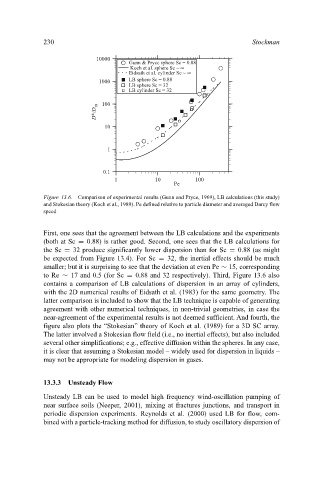
                           Figure 13.6.  Comparison of experimental results (Gunn and Pryce, 1969), LB calculations (this study)
                           and Stokesian theory (Koch et al., 1989). Pe defined relative to particle diameter and averaged Darcy flow
                           speed


                           First, one sees that the agreement between the LB calculations and the experiments
                           (both at Sc = 0.88) is rather good. Second, one sees that the LB calculations for
                           the Sc = 32 produce significantly lower dispersion than for Sc = 0.88 (as might
                           be expected from Figure 13.4). For Sc = 32, the inertial effects should be much
                           smaller; but it is surprising to see that the deviation at even Pe ∼ 15, corresponding
                           to Re ∼ 17 and 0.5 (for Sc = 0.88 and 32 respectively). Third, Figure 13.6 also
                           contains a comparison of LB calculations of dispersion in an array of cylinders,
                           with the 2D numerical results of Eidsath et al. (1983) for the same geometry. The
                           latter comparison is included to show that the LB technique is capable of generating
                           agreement with other numerical techniques, in non-trivial geometries, in case the
                           near-agreement of the experimental results is not deemed sufficient. And fourth, the
                           figure also plots the “Stokesian” theory of Koch et al. (1989) for a 3D SC array.
                           The latter involved a Stokesian flow field (i.e., no inertial effects), but also included
                           several other simplifications; e.g., effective diffusion within the spheres. In any case,
                           it is clear that assuming a Stokesian model – widely used for dispersion in liquids –
                           may not be appropriate for modeling dispersion in gases.


                           13.3.3  Unsteady Flow
                           Unsteady LB can be used to model high frequency wind-oscillation pumping of
                           near surface soils (Neeper, 2001), mixing at fractures junctions, and transport in
                           periodic dispersion experiments. Reynolds et al. (2000) used LB for flow, com-
                           bined with a particle-tracking method for diffusion, to study oscillatory dispersion of

