


Page 230 - gas transport in porous media
P. 230
Stockman
                           226
                                  Efficient Algorithms
                           13.2.4
                           The LB method can be quite calculation-intensive, and is simply not efficient for most
                           simple geometries. However, many of the problems experienced by newcomers to the
                           technique probably stem from coding inefficiencies. The calculations reported herein
                           have benefited from many speed optimizations in the source code. Some of these
                           optimizations, such as disambiguation of pointers, have been discussed previously
                           (Stockman et al., 1998). Since that publication, the code has been modified to use
                           SIMD (single-instruction, multiple data) programming, along with explicit prefetch;
                           these improvements resulted in ∼3-fold improvement in performance. The compiler
                           used for producing the executable code can make a great deal of difference. For
                           example, we found a factor 3.5 speedup in going from the most efficient version of
                           code compiled under gcc (the public domain compiler available through the GNU
                           project), to code compiled with Intel’s version 5.01 C. We found that the choice
                           of operating systems (OS; e.g., Linux vs. Microsoft Windows) made no difference
                           on the program speed, so long as the same version compiler was used on each OS.
                           Currently, the code is limited by the speed with which it can read and write vectors
                           to main memory, and performance is greatest on desktop computers with high-speed,
                           multiple-channel memory. It is notable that we have seen little improvement in the
                           code speed in 3.5 years, simply because the speed of memory access has not improved
                           greatly in that time.

                           13.3  BENCHMARKS AND ACCURACY

                           The following benchmarks illustrate the bounds of accuracy of the method, and
                           also provide background for the discussions in Section 13.5. Where necessary for
                           clarification, lu and ts units will be converted into centimeters and seconds; however,
                           most comparisons are made in dimensionless parameters. Of particular interest are
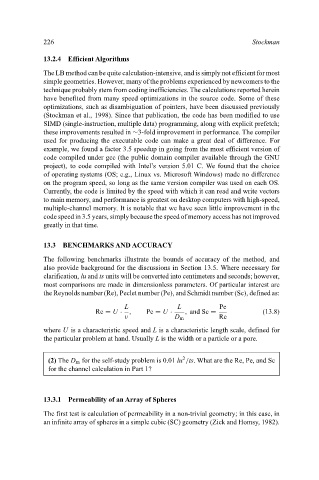
                           the Reynolds number (Re), Peclet number (Pe), and Schmidt number (Sc), defined as:
                                                  L              L           Pe
                                          Re = U ·  ,   Pe = U ·   , and Sc =            (13.8)
                                                  ν             D m          Re
                           where U is a characteristic speed and L is a characteristic length scale, defined for
                           the particular problem at hand. Usually L is the width or a particle or a pore.

                                                                  2
                            (2) The D m for the self-study problem is 0.01 lu /ts. What are the Re, Pe, and Sc
                            for the channel calculation in Part 1?


                           13.3.1  Permeability of an Array of Spheres
                           The first test is calculation of permeability in a non-trivial geometry; in this case, in
                           an infinite array of spheres in a simple cubic (SC) geometry (Zick and Homsy, 1982).

