


Page 232 - gas transport in porous media
P. 232
Stockman
                           228
                                                                                     .510
                                  .0037
                                                                                     .505
                                  .0035                                              .500
                                 Permeability/L 2  .0031            Void fraction    .490  LB Void fraction
                                                                                     .495
                                  .0033
                                                                                     .485
                                                                                     .480
                                  .0029
                                                                                     .475
                                                                                     .470
                                                                            2
                                  .0027
                                                                    Permeability/L
                                                                                     .465
                                  .0025                                              .460
                                      0   10  20  30  40   50  60  70  80  90  100  110
                                                   L = Cell edge (lattice units)
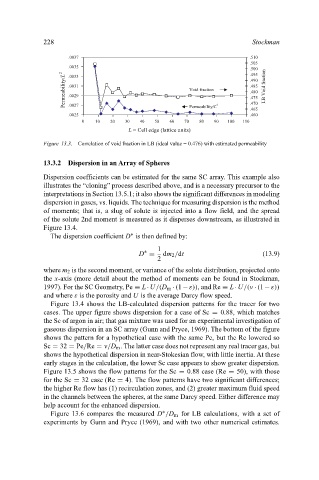
                           Figure 13.3.  Correlation of void fraction in LB (ideal value = 0.476) with estimated permeability
                           13.3.2  Dispersion in an Array of Spheres
                           Dispersion coefficients can be estimated for the same SC array. This example also
                           illustrates the “cloning” process described above, and is a necessary precursor to the
                           interpretations in Section 13.5.1; it also shows the significant differences in modeling
                           dispersion in gases, vs. liquids. The technique for measuring dispersion is the method
                           of moments; that is, a slug of solute is injected into a flow field, and the spread
                           of the solute 2nd moment is measured as it disperses downstream, as illustrated in
                           Figure 13.4.
                                                    ∗
                             The dispersion coefficient D is then defined by:
                                                           1
                                                        ∗
                                                      D =    dm 2 /dt                    (13.9)
                                                           2
                           where m 2 is the second moment, or variance of the solute distribution, projected onto
                           the x-axis (more detail about the method of moments can be found in Stockman,
                           1997). For the SC Geometry, Pe ≡ L·U/(D m ·(1−ε)), and Re ≡ L·U/(ν ·(1−ε))
                           and where ε is the porosity and U is the average Darcy flow speed.
                             Figure 13.4 shows the LB-calculated dispersion patterns for the tracer for two
                           cases. The upper figure shows dispersion for a case of Sc = 0.88, which matches
                           the Sc of argon in air; that gas mixture was used for an experimental investigation of
                           gaseous dispersion in an SC array (Gunn and Pryce, 1969). The bottom of the figure
                           shows the pattern for a hypothetical case with the same Pe, but the Re lowered so
                           Sc = 32 = Pe/Re = ν/D m . The latter case does not represent any real tracer gas, but
                           shows the hypothetical dispersion in near-Stokesian flow, with little inertia. At these
                           early stages in the calculation, the lower Sc case appears to show greater dispersion.
                           Figure 13.5 shows the flow patterns for the Sc = 0.88 case (Re = 50), with those
                           for the Sc = 32 case (Re = 4). The flow patterns have two significant differences;
                           the higher Re flow has (1) recirculation zones, and (2) greater maximum fluid speed
                           in the channels between the spheres, at the same Darcy speed. Either difference may
                           help account for the enhanced dispersion.
                                                             ∗
                             Figure 13.6 compares the measured D /D m for LB calculations, with a set of
                           experiments by Gunn and Pryce (1969), and with two other numerical estimates.

