


Page 237 - gas transport in porous media
P. 237
Chapter 13: Lattice Boltzmann Method
                                                                                           233
                           bounce-back, this fluid does not experience the free-fluid collision step, and appears
                           to have a lateral diffusion coefficient of zero.Again, tests suggest the overall error (for
                           measured vs. theoretical dispersion coefficients) is small, even for narrow channels
                           (Stockman et al., 1998). Obviously, the effect of the fluid at the interface decreases
                           as the system is scaled to use more nodes to represent the same solid.
                           13.4.2  Error in Permeability for Small Channels

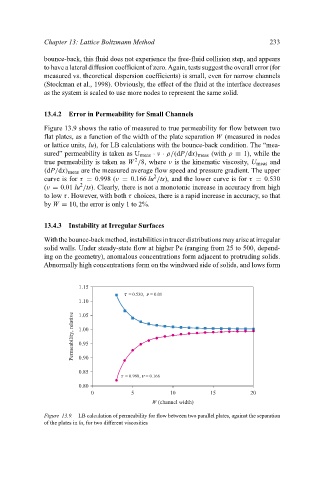
                           Figure 13.9 shows the ratio of measured to true permeability for flow between two
                           flat plates, as a function of the width of the plate separation W (measured in nodes
                           or lattice units, lu), for LB calculations with the bounce-back condition. The “mea-
                           sured” permeability is taken as U meas · ν · ρ/(dP/dx) meas (with ρ ≡ 1), while the
                                                     2
                           true permeability is taken as W /8, where ν is the kinematic viscosity, U meas and
                           (dP/dx) meas are the measured average flow speed and pressure gradient. The upper
                                                          2
                           curve is for τ = 0.998 (ν = 0.166 lu /ts), and the lower curve is for τ = 0.530
                                     2
                           (ν = 0.01 lu /ts). Clearly, there is not a monotonic increase in accuracy from high
                           to low τ. However, with both τ choices, there is a rapid increase in accuracy, so that
                           by W = 10, the error is only 1 to 2%.


                           13.4.3  Instability at Irregular Surfaces
                           Withthebounce-backmethod, instabilitiesintracerdistributionsmayariseatirregular
                           solid walls. Under steady-state flow at higher Pe (ranging from 25 to 500, depend-
                           ing on the geometry), anomalous concentrations form adjacent to protruding solids.
                           Abnormally high concentrations form on the windward side of solids, and lows form


                                     1.15
                                                  t = 0.530,  n = 0.01
                                     1.10

                                   Permeability, relative  1.00
                                     1.05


                                     0.95
                                     0.90

                                     0.85
                                                 t = 0.998, n = 0.166
                                     0.80
                                        0           5          10         15          20
                                                          W (channel width)
                           Figure 13.9.  LB calculation of permeability for flow between two parallel plates, against the separation
                           of the plates in lu, for two different viscosities

