


Page 249 - gas transport in porous media
P. 249
Šolcová and Schneider
                           246
                             Dusty Gas Model (DGM) visualizes the porous medium as a collection of giant
                           spherical molecules (dust particles) kept in space by external force. The movement of
                           gas molecules in the spaces between dust particles is described by the kinetic theory of
                                                                             2
                           gases. Formally, two of MTPM transport parameters,  r  and  r  , can be used also in
                           DGM. The third DGM transport parameter, B 0 , characterizes the viscous (Poiseuille)
                                                                      2
                           gas flow in pores and can be, formally, replaced by  r  ψ/8.
                           14.1  CONSTITUTIVE EQUATIONS
                           The net molar flux density of component i in a n-component gas mixture per unit total
                           cross-section of the porous solid, N i , due to the combined influence of composition
                           gradients and total pressure gradient in a porous solids is given as the sum of the
                                                                    p
                           permeation molar flux density of component i, N , and the diffusion molar flux
                                                                    i
                                                  d
                           density of this component, N , (Mason et al., 1967):
                                                  i
                                                       p    d
                                                 N i = N + N   i = 1, ... , n            (14.1)
                                                       i   i
                           For the net mixture molar flux density, N, it follows
                                                       p
                                                 N = N + N  d  i = 1, ... , n            (14.2)
                                                                             n
                                  d                                      d   6   d      p
                           where N is the mixture molar diffusion flux density (N =  N ) and N is the
                                                                                 i
                                                                             i=1
                                                                 n
                                                            p   6   p
                           mixture molar permeation flux density (N =  N ).
                                                                    i
                                                                i=1
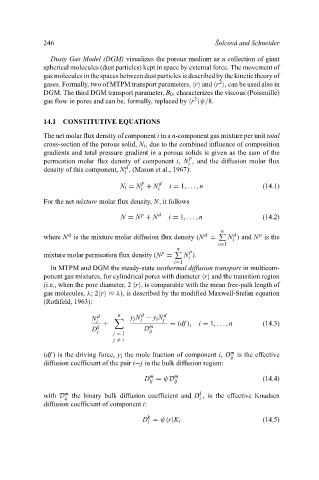
                             In MTPM and DGM the steady-state isothermal diffusion transport in multicom-
                           ponent gas mixtures, for cylindrical pores with diameter  r  and the transition region
                           (i.e., when the pore diameter, 2  r , is comparable with the mean free-path length of
                           gas molecules, λ;2 r ≈ λ), is described by the modified Maxwell-Stefan equation
                           (Rothfeld, 1963):
                                                       d
                                                n
                                         N d     y j N − y i N j d
                                                      i
                                          i  +                 = (df ) i  i = 1, ... , n  (14.3)
                                         D k            D m
                                          i    j = 1     ij
                                               j  = i
                                                                                m
                           (df ) is the driving force, y i the mole fraction of component i, D is the effective
                                                                                ij
                           diffusion coefficient of the pair i−j in the bulk diffusion region:
                                                         m      m
                                                        D = ψD  ij                       (14.4)
                                                         ij
                                 m                                     k
                           with D  the binary bulk diffusion coefficient and D , is the effective Knudsen
                                 ij                                    i
                           diffusion coefficient of component i:
                                                         k
                                                       D = ψ r K i                       (14.5)
                                                        i

