


Page 253 - gas transport in porous media
P. 253
250
                                                                                   U
                                          A                          B      Šolcová and Schneider
                                                                                  y B
                                      F A
                                     Flow-rates                              Detectors
                                      F B  B               A                       y A L


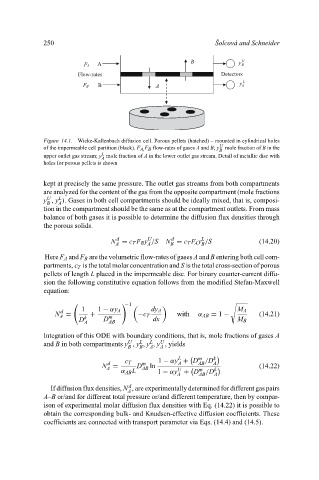
                           Figure 14.1. Wicke-Kallenbach diffusion cell. Porous pellets (hatched) – mounted in cylindrical holes
                           of the impermeable cell partition (black). F A, F B flow-rates of gases A and B; y U  mole fraction of B in the
                                                                             B
                                           L
                           upper outlet gas stream; y mole fraction of A in the lower outlet gas stream. Detail of metallic disc with
                                           A
                           holes for porous pellets is shown
                           kept at precisely the same pressure. The outlet gas streams from both compartments
                           are analyzed for the content of the gas from the opposite compartment (mole fractions
                               L
                            U
                           y , y ). Gases in both cell compartments should be ideally mixed, that is, composi-
                            B  A
                           tion in the compartment should be the same as at the compartment outlets. From mass
                           balance of both gases it is possible to determine the diffusion flux densities through
                           the porous solids.
                                                                        L
                                                d
                                                               d
                                                        U
                                              N = c T F B y /S  N = c T F A y /S        (14.20)
                                               A
                                                               B
                                                        A
                                                                        B
                           Here F A and F B are the volumetric flow-rates of gases A and B entering both cell com-
                           partments, c T is the total molar concentration and S is the total cross-section of porous
                           pellets of length L placed in the impermeable disc. For binary counter-current diffu-
                           sion the following constitutive equation follows from the modified Stefan-Maxwell
                           equation:


                                                  −1
                                      1
                                d         1 − αy A        dy A                    M A
                              N =     k  +   m        −c T       with  α AB = 1 −       (14.21)
                                A
                                     D      D             dx                      M B
                                      A      AB
                           Integration of this ODE with boundary conditions, that is, mole fractions of gases A
                                                      L
                                                            U
                                                         L
                                                   U
                           and B in both compartments y , y , y , y , yields
                                                   B  B  A  A
                                                                 L

                                                                       m
                                                                       AB
                                                                 A
                                             d    c T  m    1 − αy + D /D  k A
                                            N =      D   ln                             (14.22)
                                             A         AB        U      m  k
                                                 α AB L    1 − αy + D /D
                                                                 A     AB  A
                                                   d
                             If diffusion flux densities, N , are experimentally determined for different gas pairs
                                                   A
                           A–B or/and for different total pressure or/and different temperature, then by compar-
                           ison of experimental molar diffusion flux densities with Eq. (14.22) it is possible to
                           obtain the corresponding bulk- and Knudsen-effective diffusion coefficients. These
                           coefficients are connected with transport parameter via Eqs. (14.4) and (14.5).

