


Page 255 - gas transport in porous media
P. 255
Šolcová and Schneider
                           252
                           cell. Different gases A and B flow steadily through the both compartments until
                           the steady state is established. Inlet flow-rates of gases A and B should be high
                           enough to guarantee that gases flowing from both compartments are nearly pure (i.e.,
                                 L
                                            L
                           y U  = y = 1 and y = y U  = 0). After the gas inlet and outlet in one of the cell
                            A    B          A    B
                           compartment is stopped, the net volumetric diffusion flux is determined. For this
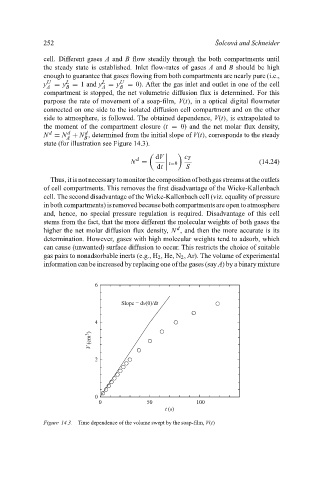
                           purpose the rate of movement of a soap-film, V(t), in a optical digital flowmeter
                           connected on one side to the isolated diffusion cell compartment and on the other
                           side to atmosphere, is followed. The obtained dependence, V(t), is extrapolated to
                           the moment of the compartment closure (t = 0) and the net molar flux density,
                             d
                                  d
                                       d
                           N = N + N , determined from the initial slope of V(t), corresponds to the steady
                                  A   B
                           state (for illustration see Figure 14.3).

                                                     d     dV      c T
                                                    N =         t=0                     (14.24)

                                                           dt      S
                             Thus, itisnotnecessarytomonitorthecompositionofbothgasstreamsattheoutlets
                           of cell compartments. This removes the first disadvantage of the Wicke-Kallenbach
                           cell. The second disadvantage of the Wicke-Kallenbach cell (viz. equality of pressure
                           in both compartments) is removed because both compartments are open to atmosphere
                           and, hence, no special pressure regulation is required. Disadvantage of this cell
                           stems from the fact, that the more different the molecular weights of both gases the
                                                                 d
                           higher the net molar diffusion flux density, N , and then the more accurate is its
                           determination. However, gases with high molecular weights tend to adsorb, which
                           can cause (unwanted) surface diffusion to occur. This restricts the choice of suitable
                           gas pairs to nonadsorbable inerts (e.g., H 2 , He, N 2 , Ar). The volume of experimental
                           information can be increased by replacing one of the gases (say A) by a binary mixture
                                          6

                                                 Slope = dv(0)/dt


                                          4
                                        V (cm 3 )


                                          2


                                          0
                                           0            50            100
                                                             t (s)

                           Figure 14.3. Time dependence of the volume swept by the soap-film, V(t)

