


Page 258 - gas transport in porous media
P. 258
Chapter 14: Experimental Determination of Transport Parameters
                                                      1       2                            255

                                                                   5

                                                              3


                                                       4
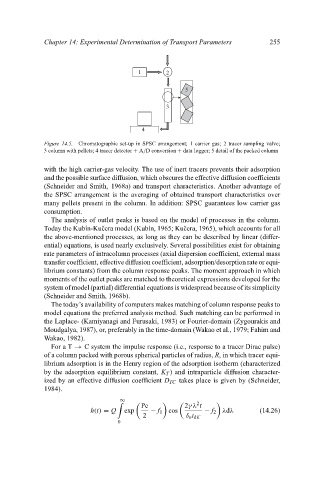
                           Figure 14.5.  Chromatographic set-up in SPSC arrangement; 1 carrier gas; 2 tracer sampling valve;
                           3 column with pellets; 4 tracer detector + A/D conversion + data logger; 5 detail of the packed column

                           with the high carrier-gas velocity. The use of inert tracers prevents their adsorption
                           and the possible surface diffusion, which obscures the effective diffusion coefficients
                           (Schneider and Smith, 1968a) and transport characteristics. Another advantage of
                           the SPSC arrangement is the averaging of obtained transport characteristics over
                           many pellets present in the column. In addition: SPSC guarantees low carrier gas
                           consumption.
                             The analysis of outlet peaks is based on the model of processes in the column.
                           Today the Kubín-Kuˇcera model (Kubín, 1965; Kuˇcera, 1965), which accounts for all
                           the above-mentioned processes, as long as they can be described by linear (differ-
                           ential) equations, is used nearly exclusively. Several possibilities exist for obtaining
                           rate parameters of intracolumn processes (axial dispersion coefficient, external mass
                           transfer coefficient, effective diffusion coefficient, adsorption/desorption rate or equi-
                           librium constants) from the column response peaks. The moment approach in which
                           moments of the outlet peaks are matched to theoretical expressions developed for the
                           system of model (partial) differential equations is widespread because of its simplicity
                           (Schneider and Smith, 1968b).
                             The today’s availability of computers makes matching of column response peaks to
                           model equations the preferred analysis method. Such matching can be performed in
                           the Laplace- (Kamiyanagi and Furusaki, 1983) or Fourier-domain (Zygourakis and
                           Moudgalya, 1987), or, preferably in the time-domain (Wakao et al., 1979; Fahim and
                           Wakao, 1982).
                             ForaT → C system the impulse response (i.e., response to a tracer Dirac pulse)
                           of a column packed with porous spherical particles of radius, R, in which tracer equi-
                           librium adsorption is in the Henry region of the adsorption isotherm (characterized
                           by the adsorption equilibrium constant, K T ) and intraparticle diffusion character-
                           ized by an effective diffusion coefficient D TC takes place is given by (Schneider,
                           1984).
                                                 ∞

                                                                      2
                                                       Pe          2γλ t
                                        h(t) = Q  exp    − f 1 cos       − f 2 λdλ      (14.26)
                                                       2           δ o t dif
                                                0

