


Page 260 - gas transport in porous media
P. 260
Chapter 14: Experimental Determination of Transport Parameters
                                                       3   2             1                 257


                                         c/c max


                                          0           10           20          0

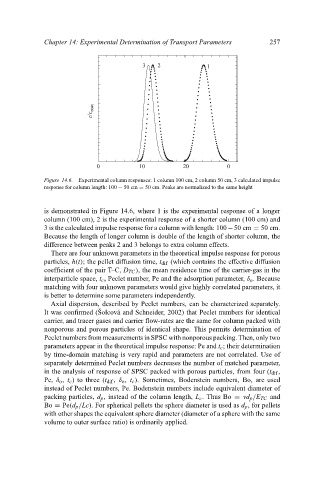
                           Figure 14.6.  Experimental column responses: 1 column 100 cm, 2 column 50 cm, 3 calculated impulse
                           response for column length: 100 − 50 cm = 50 cm. Peaks are normalized to the same height


                           is demonstrated in Figure 14.6, where 1 is the experimental response of a longer
                           column (100 cm), 2 is the experimental response of a shorter column (100 cm) and
                           3 is the calculated impulse response for a column with length: 100−50 cm = 50 cm.
                           Because the length of longer column is double of the length of shorter column, the
                           difference between peaks 2 and 3 belongs to extra column effects.
                             There are four unknown parameters in the theoretical impulse response for porous
                           particles, h(t); the pellet diffusion time, t dif (which contains the effective diffusion
                           coefficient of the pair T–C, D TC ), the mean residence time of the carrier-gas in the
                           interparticle space, t c , Peclet number, Pe and the adsorption parameter, δ o . Because
                           matching with four unknown parameters would give highly correlated parameters, it
                           is better to determine some parameters independently.
                             Axial dispersion, described by Peclet numbers, can be characterized separately.
                           It was confirmed (Šolcová and Schneider, 2002) that Peclet numbers for identical
                           carrier, and tracer gases and carrier flow-rates are the same for column packed with
                           nonporous and porous particles of identical shape. This permits determination of
                           Peclet numbers from measurements in SPSC with nonporous packing. Then, only two
                           parameters appear in the theoretical impulse response: Pe and t c ; their determination
                           by time-domain matching is very rapid and parameters are not correlated. Use of
                           separately determined Peclet numbers decreases the number of matched parameter,
                           in the analysis of response of SPSC packed with porous particles, from four (t dif ,
                           Pe, δ o , t c ) to three (t dif , δ o , t c ). Sometimes, Bodenstein numbers, Bo, are used
                           instead of Peclet numbers, Pe. Bodenstein numbers include equivalent diameter of
                           packing particles, d p , instead of the column length, L c . Thus Bo = vd p /E TC and
                           Bo = Pe(d p /Lc). For spherical pellets the sphere diameter is used as d p , for pellets
                           with other shapes the equivalent sphere diameter (diameter of a sphere with the same
                           volume to outer surface ratio) is ordinarily applied.

