


Page 264 - gas transport in porous media
P. 264
261
                           Chapter 14: Experimental Determination of Transport Parameters
                                                       o
                           amount (usually 500–900 Pa),  P , and the gas inlet is closed. The time-change of
                           the pressure difference between compartments,  P(t), is followed by the differential
                           pressure transducer.
                                                                           p
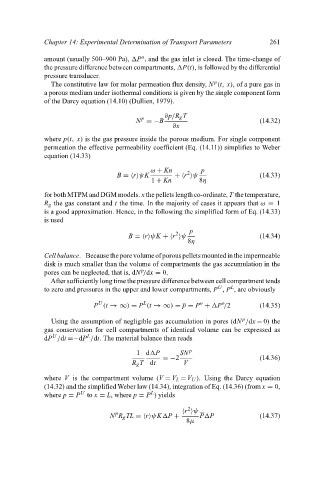
                             The constitutive law for molar permeation flux density, N (t, x), of a pure gas in
                           a porous medium under isothermal conditions is given by the single component form
                           of the Darcy equation (14.10) (Dullien, 1979).
                                                             ∂p/R g T
                                                       p
                                                     N =−B                              (14.32)
                                                                ∂x
                           where p(t, x) is the gas pressure inside the porous medium. For single component
                           permeation the effective permeability coefficient (Eq. (14.11)) simplifies to Weber
                           equation (14.33)
                                                         ω + Kn     2   p
                                                B = r ψK        + r  ψ                  (14.33)
                                                          1 + Kn       8η
                           for both MTPM and DGM models. x the pellets length co-ordinate, T the temperature,
                           R g the gas constant and t the time. In the majority of cases it appears that ω = 1
                           is a good approximation. Hence, in the following the simplified form of Eq. (14.33)
                           is used
                                                                    p
                                                                2
                                                   B = r ψK + r  ψ                      (14.34)
                                                                    8η
                           Cellbalance. Becausetheporevolumeofporouspelletsmountedintheimpermeable
                           disk is much smaller than the volume of compartments the gas accumulation in the
                                                       p
                           pores can be neglected, that is, dN /dx = 0.
                             After sufficiently long time the pressure difference between cell compartment tends
                                                                                L
                                                                            U
                           to zero and pressures in the upper and lower compartments, P , P , are obviously
                                                                              o
                                                                       o
                                                       L
                                           U
                                         P (t →∞) = P (t →∞) = p = P +  P /2            (14.35)
                                                                                   p
                             Using the assumption of negligible gas accumulation in pores (dN /dx = 0) the
                           gas conservation for cell compartments of identical volume can be expressed as
                             U
                                       L
                           dP /dt =−dP /dt. The material balance then reads
                                                     1 d P        SN p
                                                             =−2                        (14.36)
                                                    R g T dt       V
                           where V is the compartment volume (V = V L = V U ). Using the Darcy equation
                           (14.32) and the simplified Weber law (14.34), integration of Eq. (14.36) (from x = 0,
                                                         L
                                     U
                           where p = P to x = L, where p = P ) yields
                                                                    2
                                                                   r  ψ
                                               p
                                              N R g TL = r ψK P +      P P              (14.37)
                                                                   8µ

