


Page 261 - gas transport in porous media
P. 261
258
                                                                                          1
                                10 1                                        Šolcová and Schneider
                                                                                         10


                               Bo


                                10 0                                                     10 0


                                  10 0        10 1         10 2           10 1         10 2
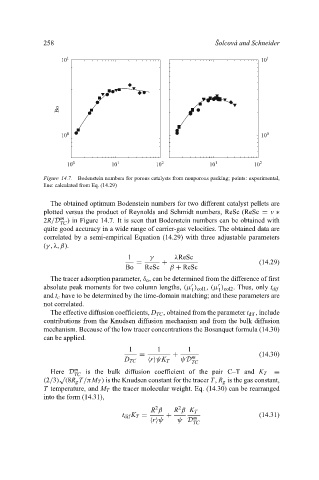
                           Figure 14.7.  Bodenstein numbers for porous catalysts from nonporous packing; points: experimental,
                           line: calculated from Eq. (14.29)

                             The obtained optimum Bodenstein numbers for two different catalyst pellets are
                           plotted versus the product of Reynolds and Schmidt numbers, ReSc (ReSc = v ∗
                                m
                           2R/D   ) in Figure 14.7. It is seen that Bodenstein numbers can be obtained with
                                TC
                           quite good accuracy in a wide range of carrier-gas velocities. The obtained data are
                           correlated by a semi-empirical Equation (14.29) with three adjustable parameters
                           (γ , λ, β).
                                                   1     γ      λReSc
                                                     =       +                          (14.29)
                                                  Bo    ReSc   β + ReSc
                             The tracer adsorption parameter, δ o , can be determined from the difference of first

                           absolute peak moments for two column lengths, (µ ) col1 , (µ ) col2 . Thus, only t dif
                                                                     1      1
                           and t c have to be determined by the time-domain matching; and these parameters are
                           not correlated.
                             The effective diffusion coefficients, D TC , obtained from the parameter t dif , include
                           contributions from the Knudsen diffusion mechanism and from the bulk diffusion
                           mechanism. Because of the low tracer concentrations the Bosanquet formula (14.30)
                           can be applied.
                                                   1       1        1
                                                      =         +    m                  (14.30)
                                                  D TC    r ψK T  ψD
                                                                     TC
                                    m
                             Here D TC  is the bulk diffusion coefficient of the pair C–T and K T  ≡
                               √
                           (2/3) (8R g T/πM T ) is the Knudsen constant for the tracer T, R g is the gas constant,
                           T temperature, and M T the tracer molecular weight. Eq. (14.30) can be rearranged
                           into the form (14.31),
                                                           2
                                                                 2
                                                         R β    R β K T
                                                 t dif K T =  +      m                  (14.31)
                                                          r ψ    ψ D
                                                                     TC

