


Page 268 - gas transport in porous media
P. 268
Chapter 14: Experimental Determination of Transport Parameters
                                                Full                                       265
                                         100                                  100
                                                solution

                                                           Simplified
                                        p (kPa)  50        solution           50  p (kPa)


                                           0                                  0
                                            0    0            500          1000
                                                           t (s)
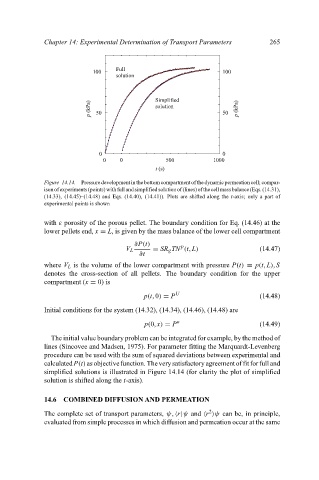
                           Figure 14.14.  Pressuredevelopmentinthebottomcompartmentofthedynamicpermeationcell; compar-
                           isonofexperiments(points)withfullandsimplifiedsolutionof(lines)ofthecellmassbalance(Eqs.(14.31),
                           (14.33), (14.45)–(14.48) and Eqs. (14.40), (14.41)). Plots are shifted along the t-axis; only a part of
                           experimental points is shown

                           with ε porosity of the porous pellet. The boundary condition for Eq. (14.46) at the
                           lower pellets end, x = L, is given by the mass balance of the lower cell compartment
                                                     ∂P(t)        p
                                                  V L     = SR g TN (t, L)              (14.47)
                                                      ∂t
                           where V L is the volume of the lower compartment with pressure P(t) ≡ p(t, L), S
                           denotes the cross-section of all pellets. The boundary condition for the upper
                           compartment (x = 0) is
                                                       p(t,0) = P U                     (14.48)

                           Initial conditions for the system (14.32), (14.34), (14.46), (14.48) are
                                                        p(0, x) = P o                   (14.49)

                             The initial value boundary problem can be integrated for example, by the method of
                           lines (Sincovee and Madsen, 1975). For parameter fitting the Marquardt-Levenberg
                           procedure can be used with the sum of squared deviations between experimental and
                           calculatedP(t)asobjectivefunction. Theverysatisfactoryagreementoffitforfulland
                           simplified solutions is illustrated in Figure 14.14 (for clarity the plot of simplified
                           solution is shifted along the t-axis).


                           14.6  COMBINED DIFFUSION AND PERMEATION
                                                                          2
                           The complete set of transport parameters, ψ,  r ψ and  r  ψ can be, in principle,
                           evaluated from simple processes in which diffusion and permeation occur at the same

