


Page 271 - gas transport in porous media
P. 271
268
                                                                                         1.4
                              1.4                                           Šolcová and Schneider
                                                                               He → Ar
                                                H → Ar                         He → N
                                                 2
                                                                                     2
                                                H → N 2                        He → H 2
                                                 2
                             p rel  1.2                                                  1.2  p rel
                                                H → He
                                                 2
                              1.0                                                        1.0


                              1.0                                                        1.0


                                                                             Ar → N
                                                                                  2
                             p rel  0.8                                      Ar → He     0.8  p rel
                                                N → Ar                       Ar → H
                                                 2                                2
                                                N → He
                                                 2
                                                N → H
                                                 2    2
                              0.6                                                        0.6
                                0        100      200       0       100       200      300
                                             t (s)                       t (s)
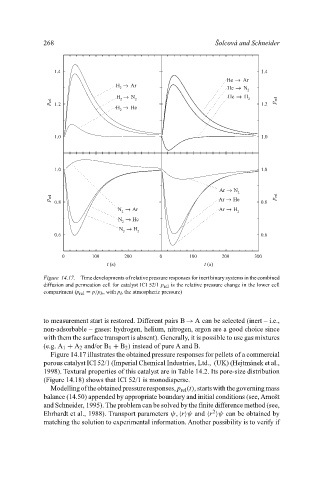
                           Figure 14.17. Time developments of relative pressure responses for inert binary systems in the combined
                           diffusion and permeation cell for catalyst ICI 52/1 p rel is the relative pressure change in the lower cell
                           compartment (p rel = p/p b , with p b the atmospheric pressure)


                           to measurement start is restored. Different pairs B → A can be selected (inert – i.e.,
                           non-adsorbable – gases: hydrogen, helium, nitrogen, argon are a good choice since
                           with them the surface transport is absent). Generally, it is possible to use gas mixtures
                           (e.g. A 1 + A 2 and/or B 1 + B 2 ) instead of pure A and B.
                             Figure 14.17 illustrates the obtained pressure responses for pellets of a commercial
                           porous catalyst ICI 52/1 (Imperial Chemical Industries, Ltd., (UK) (Hejtmánek et al.,
                           1998). Textural properties of this catalyst are in Table 14.2. Its pore-size distribution
                           (Figure 14.18) shows that ICI 52/1 is monodisperse.
                             Modellingoftheobtainedpressureresponses, p rel (t), startswiththegoverningmass
                           balance (14.50) appended by appropriate boundary and initial conditions (see, Arnošt
                           and Schneider, 1995). The problem can be solved by the finite difference method (see,
                                                                           2
                           Ehrhardt et al., 1988). Transport parameters ψ,  r ψ and  r  ψ can be obtained by
                           matching the solution to experimental information. Another possibility is to verify if

