


Page 314 - gas transport in porous media
P. 314
Chapter 18: Measurement of Vapor Concentrations
                           are not very durable and have short shelf lives. Subject to interfering gases such as
                           hydrogen.                                                       313
                           18.4  MASS SENSORS

                           18.4.1  Surface Acoustic Wave Sensors/
                           Portable Acoustic Wave Sensors

                           Surface Acoustic Wave Sensors (SAWS) are small miniature sensors used to detect
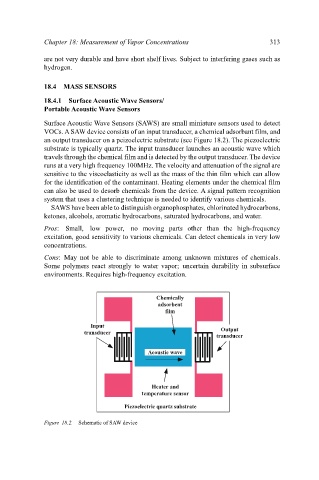
                           VOCs. A SAW device consists of an input transducer, a chemical adsorbant film, and
                           an output transducer on a peizoelectric substrate (see Figure 18.2). The piezoelectric
                           substrate is typically quartz. The input transducer launches an acoustic wave which
                           travels through the chemical film and is detected by the output transducer. The device
                           runs at a very high frequency 100MHz. The velocity and attenuation of the signal are
                           sensitive to the viscoelasticity as well as the mass of the thin film which can allow
                           for the identification of the contaminant. Heating elements under the chemical film
                           can also be used to desorb chemicals from the device. A signal pattern recognition
                           system that uses a clustering technique is needed to identify various chemicals.
                             SAWS have been able to distinguish organophosphates, chlorinated hydrocarbons,
                           ketones, alcohols, aromatic hydrocarbons, saturated hydrocarbons, and water.
                           Pros: Small, low power, no moving parts other than the high-frequency
                           excitation, good sensitivity to various chemicals. Can detect chemicals in very low
                           concentrations.
                           Cons: May not be able to discriminate among unknown mixtures of chemicals.
                           Some polymers react strongly to water vapor; uncertain durability in subsurface
                           environments. Requires high-frequency excitation.


                                                           Chemically
                                                           adsorbent
                                                             film
                                        Input
                                      transducer                             Output
                                                                            transducer
                                                         Acoustic wave


                                                          Heater and
                                                       temperature sensor

                                                  Piezoelectric quartz substrate

                           Figure 18.2.  Schematic of SAW device

