


Page 119 - Geochemical Remote Sensing of The Sub-Surface
P. 119
96                                                            S.M.  Hamilton


              1.2  x  ~O~.__  Theoretical upper limit of water stability
             !.(i   JiO  --  r
                      "r ~/..,.,
                      9  I   ..0%
             0.8  :;,"   ~   x
                               I~  Extreme empirical
             0.6   I     ~   "x,,,.Ld""  limits tbr terrestrial
                 I             I  ~  ters  ..
                 I
             0.4                  as,..--
             (1.2     i
             ,,0      ,                  '
             -0.2   II2N  "~
             -0.4   ., , / ,  " O. ~ ~
                 Jncorctical   -,ojt ,~
                  lower limit of
             -0.6   water stability
                   2   4   6   8   i0   12   13
                          pl!
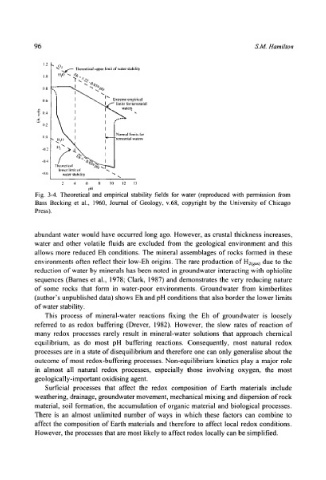
           Fig. 3-4. Theoretical and  empirical stability  fields for water  (reproduced  with  permission  from
           Bass Becking et  al., 1960, Journal of Geology,  v.68, copyright  by  the  University  of Chicago
           Press).


           abundant  water  would  have  occurred  long ago.  However,  as  crustal  thickness  increases,
           water  and  other  volatile  fluids  are  excluded  from  the  geological  environment  and  this
           allows  more  reduced  Eh  conditions.  The  mineral  assemblages  of rocks  formed  in  these
           environments often  reflect their low-Eh origins.  The  rare production  of H2(g,s) due  to the
           reduction  of water by minerals  has been  noted  in groundwater  interacting  with  ophiolite
           sequences  (Barnes  et  al.,  1978;  Clark,  1987)  and  demonstrates  the  very reducing  nature
           of  some  rocks  that  form  in  water-poor  environments.  Groundwater  from  kimberlites
           (author's unpublished data) shows Eh and pH conditions that also border the lower limits
           of water stability.
              This  process  of  mineral-water  reactions  fixing  the  Eh  of  groundwater  is  loosely
           referred  to  as  redox  buffering  (Drever,  1982).  However,  the  slow  rates  of  reaction  of
           many  redox  processes  rarely  result  in  mineral-water  solutions  that  approach  chemical
           equilibrium,  as  do  most  pH  buffering  reactions.  Consequently,  most  natural  redox
           processes are in a state of disequilibrium  and therefore one can only generalise about the
           outcome  of most redox-buffering  processes.  Non-equilibrium  kinetics  play  a  major  role
           in  almost  all  natural  redox  processes,  especially  those  involving  oxygen,  the  most
           geologically-important oxidising agent.
              Surficial  processes  that  affect  the  redox  composition  of  Earth  materials  include
           weathering, drainage, groundwater movement, mechanical  mixing and dispersion of rock
           material,  soil  formation,  the  accumulation  of organic  material  and  biological  processes.
           There  is  an  almost  unlimited  number  of ways  in  which  these  factors  can  combine  to
           affect  the  composition  of Earth  materials  and  therefore  to  affect  local  redox  conditions.
           However, the processes that are most likely to affect redox locally can be simplified.

