


Page 123 - Geochemical Remote Sensing of The Sub-Surface
P. 123
1 O0                                                          S.M. Hamilton
                          lz;arth'S' surtace    "."
                                               (mV)
                . . . . . . . . . . . . . . . . . . . . . . . . . . . . . .  .  . . . .  4-600


                                              .  +400
                  iii  iii ;  iiiiiiiiiiii


            u,I
            O
                !iiii )ill iiiiiiill iiiii.
             i   '
             I
             7'
                                                -400


                         Earth's Lower Crust
                                             _  _  .  .
                  Increasing Eh
             H  < d (t~ < c 0~ < b  9 < a (-~<O  Positive Charge Carriers
             H  < D <-'~ <C (-3 <B (-) <A ~) <O   Negative Charge Carriers

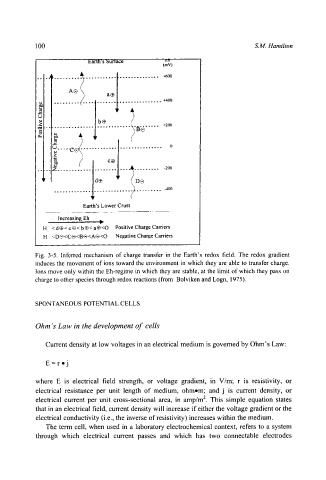
           Fig.  3-5.  Inferred  mechanism  of charge  transfer  in  the  Earth's  redox  field.  The  redox  gradient
           induces  the  movement of ions  toward  the environment  in  which  they are able to transfer charge.
           Ions move only  within the  Eh-regime in which  they are stable, at the limit of which  they pass  on
           charge to other species through redox reactions (from  Bolviken and Logn,  1975).


           SPONTANEOUS  POTENTIAL  CELLS


           Ohm's  Law  in the development of  cells

              Current  density  at low  voltages  in an electrical  medium  is governed  by  Ohm's  Law:


              E=r,j

           where  E  is  electrical  field  strength,  or  voltage  gradient,  in  V/m;  r  is  resistivity,  or
           electrical  resistance  per  unit  length  of  medium,  ohmem;  and  j  is  current  density,  or
           electrical  current  per  unit  cross-sectional  area,  in  amp/m 2.  This  simple  equation  states
           that  in an  electrical  field,  current  density  will  increase  if either the  voltage  gradient  or the
           electrical  conductivity  (i.e., the  inverse  of resistivity)  increases within  the  medium.
              The  term  cell,  when  used  in  a  laboratory  electrochemical  context,  refers  to  a  system
           through  which  electrical  current  passes  and  which  has  two  connectable  electrodes

