


Page 126 - Geochemical Remote Sensing of The Sub-Surface
P. 126
Spontaneous potentials and electrochemical cells                      103


                      t .....  \,  ......... I .........................


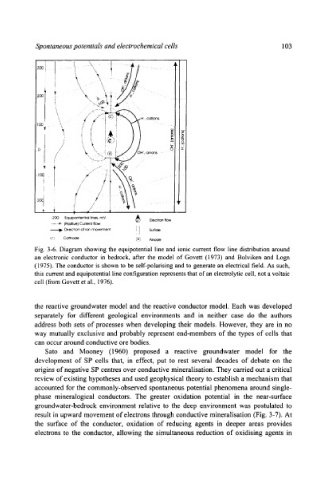
                -200  Equipontential lines, mY.   ~   Electron flow
                  --'- (Positive} Current flow
                   Direction of ion movement   ~{ J   Sulfide
               (c)   Cathode            (4)   Anode
           Fig. 3-6. Diagram showing the equipotential  line and ionic current  flow line distribution  around
           an  electronic  conductor  in  bedrock,  after  the  model  of Govett  (1973) and  Bolviken  and  Logn
           (1975). The conductor  is shown to be sel[-polafising and to generate an electrical  field. As such,
           this current and equipotential line configuration represents that of" an electrolytic cell, not a voltaic
           cell (from Govett et al., 1976).


           the  reactive  groundwater  model  and  the  reactive  conductor  model.  Each  was  developed
           separately  for  different  geological  environments  and  in  neither  case  do  the  authors
           address  both  sets  of processes  when  developing  their  models.  However,  they  are  in  no
           way  mutually  exclusive  and  probably  represent  end-members  of the  types  of cells  that
           can occur around conductive ore bodies.
              Sato  and  Mooney  (1960)  proposed  a  reactive  groundwater  model  for  the
           development  of  SP  cells  that,  in  effect,  put  to  rest  several  decades  of  debate  on  the
           origins of negative SP centres over conductive mineralisation.  They carried out a critical
           review of existing hypotheses and used geophysical theory to establish a mechanism that
           accounted  for the  commonly-observed spontaneous  potential  phenomena  around  single-
           phase  mineralogical  conductors.  The  greater  oxidation  potential  in  the  near-surface
           groundwater-bedrock  environment  relative  to  the  deep  environment  was  postulated  to
           result in upward  movement of electrons through conductive mineralisation (Fig.  3-7).  At
           the  surface  of  the  conductor,  oxidation  of  reducing  agents  in  deeper  areas  provides
           electrons  to  the  conductor,  allowing  the  simultaneous  reduction  of  oxidising  agents  in

