


Page 127 - Geochemical Remote Sensing of The Sub-Surface
P. 127
104                                                           S.M.  Hamilton
                                             " 'k i
                [  .t  t.-  ~ .....  J
             ...     \\   \    "
                                                I
            +200   T   "     -."  7(~)--)   "
                /     ~     ..-   4 .....   I.   '   ........   "~   E.I

            +100     --   ~   "       . . . . . . . . . . . . . . . .  .'3"-
                       §
                  ..   J      ..~.     . . . . . . .  O
                       ,       (e)
             mV   -    i               . . . . . . . . . .  ~   .
                       /            ,--
                      l
                      J
                                      .........  _~.  ~...
                      /
            1 O0   -   /     .~,  (5)
                    " :/   ~   //      ..   .-   ,
                    /   i   ;   .   .     ..   .
            -200
                    ,   .   j  .  .  .  .  .
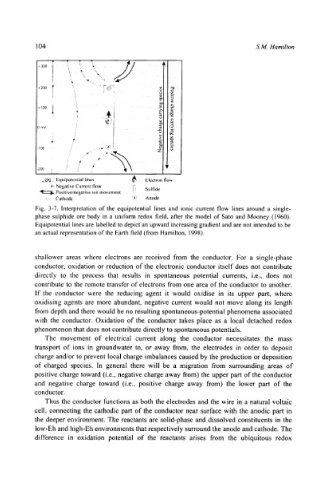
             ..-L0~..  Equipotentiai  lines   ~,   Electron  flow
                .,-  Negative  Current  flow   Sulfide
                 Positive/negative  ion  movement   Im
              ~,q:  Cathode           r.X)   Anode
           Fig.  3-7.  Interpretation of  the  equipotential  lines  and  ionic  current flow  lines  around a  single-
           phase  sulphide  ore  body  in a uniform redox  field,  after the model  of Sato  and  Mooney  (1960).
           Equipotential lines are labelled to depict an upward increasing gradient and are not intended to be
           an actual representation of the Earth field (from Hamilton,  1998).


           shallower  areas  where  electrons  are  received  from  the  conductor.  For  a  single-phase
           conductor,  oxidation  or  reduction  of  the  electronic  conductor  itself  does  not  contribute
           directly  to  the  process  that  results  in  spontaneous  potential  currents,  i.e.,  does  not
           contribute  to  the  remote  transfer  of electrons  from  one  area  of the  conductor  to  another.
           If  the  conductor  were  the  reducing  agent  it  would  oxidise  in  its  upper  part,  where
           oxidising  agents  are  more  abundant,  negative  current  would  not  move  along  its  length
           from  depth  and there would  be no resulting  spontaneous-potential  phenomena  associated
           with  the  conductor.  Oxidation  of  the  conductor  takes  place  as  a  local  detached  redox
           phenomenon  that does  not contribute directly  to spontaneous  potentials.
              The  movement  of  electrical  current  along  the  conductor  necessitates  the  mass
           transport  of  ions  in  groundwater  to,  or  away  from,  the  electrodes  in  order  to  deposit
           charge  and/or to prevent  local  charge  imbalances  caused  by  the production  or deposition
           of  charged  species.  In  general  there  will  be  a  migration  from  surrounding  areas  of
           positive  charge  toward  (i.e.,  negative  charge  away  from)  the  upper part of the  conductor
           and  negative  charge  toward  (i.e.,  positive  charge  away  from)  the  lower  part  of  the
           conductor.
              Thus  the  conductor  functions  as  both  the  electrodes  and  the  wire  in  a  natural  voltaic
           cell,  connecting  the  cathodic  part  of  the  conductor  near  surface  with  the  anodic  part  in
           the  deeper  environment.  The  reactants  are  solid-phase  and  dissolved  constituents  in  the
           low-Eh  and high-Eh environments  that respectively  surround the anode  and cathode.  The
           difference  in  oxidation  potential  of  the  reactants  arises  from  the  ubiquitous  redox

