


Page 125 - Geochemical Remote Sensing of The Sub-Surface
P. 125
102                                                           S.M.  Hamilton

           cells  in  the  Earth  were  based  on  a  fundamental  false  premise.  The  problems  stem  from
           the  fact  that  most  authors  (e.g.,  Bolviken  and  Logn,  1975;  Govett,  1976;  Sivenas  and
           Beales,  1982;  Smee,  1983;  Clark,  1997),  inadvertently  or  otherwise,  saw  the  conductor
           itself  as  the  voltaic  cell.  This  led  to  models  involving  self-polarising  conductors  that
           generated  their  own  electrical  field  within  the  Earth's  redox  field  (Fig.  3-6).  When
           considering  the  conductor  and  the  Earth  electrolyte  as  a  whole,  the  result  was  an
           electrolytic cell,  not a voltaic  cell.  Hamilton  (1998)  provides  an  in-depth  treatment of the
           theoretical problems with  some of these models.


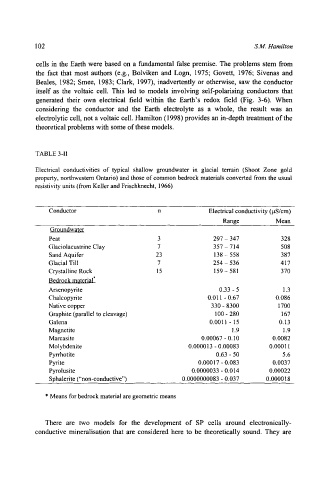
           TABLE 3-II

           Electrical  conductivities  of  typical  shallow  groundwater  in  glacial  terrain  (Shoot  Zone  gold
           property, northwestern Ontario) and those of common bedrock materials converted from the usual
           resistivity units (from Keller and Frischknecht,  1966)


               Conductor                      n             Electrical conductivity (~tS/cm)
                                                                Range          Mean
               Groundwater
               Peat                           3              297-  347          328
               Glaciolacustrine Clay          7              357-  714          508
               Sand Aquifer                  23               138 -  558        387
               Glacial Till                   7              254 -  536         417
               Crystalline Rock              15               159-  581         370
               Bedrock material"
               Arsenopyrite                                    0.33 - 5          1.3
               Chalcopyrite                                 0.011  - 0.67      0.086
               Native copper                                 330 - 8300         1700
               Graphite (parallel to cleavage)                100 - 280          167
               Galena                                       0.0011  15          0.13
                                                                  -
               Magnetite                                           1.9           1.9
               Marcasite                                  0.00067 - 0.10      0.0082
               Molybdenite                            0.000013 - 0.00083     0.00011
               Pyrrhotite                                     0.63 - 50          5.6
               Pyrite                                    0.00017 - 0.083      0.0037
               Pyrolusite                              0.0000033 - 0.014     0.00022
               Sphalerite ("non-conductive")         0.0000000083  - 0.037   0.000018

              * Means for bedrock material are geometric means


              There  are  two  models  for  the  development  of  SP  cells  around  electronically-
           conductive  mineralisation  that  are  considered  here  to  be  theoretically  sound.  They  are

