


Page 129 - Geochemical Remote Sensing of The Sub-Surface
P. 129
106                                                           S.M. Hamilton

             +300  .................   .......      " .......   "  -id
                           ]
                l
                       .....  - .....   9 ...   ii   ,,.  ........
             .....  ~  --Negative  Current   ........................
                     Flow  Lines  .~.   3', .....   ...........   O
              ~  .... -..  ....        ,.,     9      .0
                                       ~    -.        "~..
                                            Pyrite        r
                             ..,..."       ..         ~
             + ]ool-  ...............................................  ~  ....
                                                          0"Q
             Fe S 1__~ 4FeS  +  3Fe  +  6e }"/"  j''~Jr   ,.,  "  ....   r  t.~
               ,       ,     .   :         ....................   ~,   _   .
                                                          r  ,...,.
            0  mV           .  .  .  .  .  .  .  .  .  .  .  .  .  .  .  .  .  .  .  .  .  .  .  Z

                            ........   -   ,,.  ...............................
            -]00
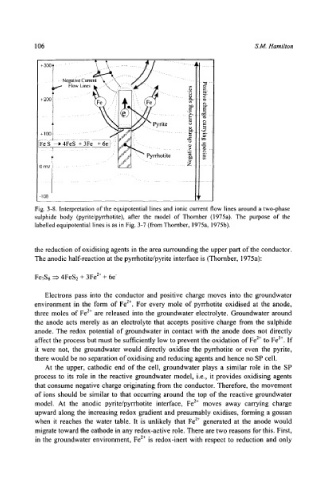
           Fig. 3-8.  Interpretation of the equipotential lines and ionic current flow  lines around a two-phase
           sulphide  body  (pyrite/pyrrhotite), after the  model  of  Thornber (1975a).  The  purpose of  the
           labelled equipotential lines is as in Fig. 3-7 (from Thornber, 1975a, 1975b).


           the reduction  of oxidising  agents  in the area surrounding the upper part of the conductor.
           The anodic  half-reaction  at the pyrrhotite/pyrite  interface  is (Thornber,  1975a):

           FeTS8 ~  4FeS/+  3Fe 2+ +  6e-

              Electrons  pass  into  the  conductor  and  positive  charge  moves  into  the  groundwater
           environment  in  the  form  of  Fe 2§  For  every  mole  of  pyrrhotite  oxidised  at  the  anode,
           three  moles  of  Fe 2§  are  released  into  the  groundwater  electrolyte.  Groundwater  around
           the  anode  acts  merely  as  an  electrolyte  that  accepts  positive  charge  from  the  sulphide
           anode.  The  redox  potential  of  groundwater  in  contact  with  the  anode  does  not  directly
           affect the process  but must be sufficiently  low  to prevent the oxidation  of Fe 2§ to  Fe 3§  If
           it  were  not,  the  groundwater  would  directly  oxidise  the  pyrrhotite  or  even  the  pyrite,
           there would be no separation of oxidising  and reducing agents and hence no SP cell.
              At  the  upper,  cathodic  end  of  the  cell,  groundwater  plays  a  similar  role  in  the  SP
           process  to  its  role  in  the  reactive  groundwater  model,  i.e.,  it  provides  oxidising  agents
           that  consume  negative  charge  originating  from  the  conductor.  Therefore,  the  movement
           of  ions  should  be  similar  to  that  occurring  around  the  top  of  the  reactive  groundwater
           model.  At  the  anodic  pyrite/pyrrhotite  interface,  Fe 2+  moves  away  carrying  charge
           upward  along  the  increasing  redox  gradient  and presumably  oxidises,  forming  a  gossan
           when  it  reaches  the  water  table.  It  is  unlikely  that  Fe 2§  generated  at  the  anode  would
           migrate toward the cathode  in any redox-active  role.  There are two reasons  for this. First,
           in  the  groundwater  environment,  Fe 2§  is  redox-inert  with  respect  to  reduction  and  only

