


Page 132 - Geochemical Remote Sensing of The Sub-Surface
P. 132
Spontaneous potentials and electrochemical cells                     109


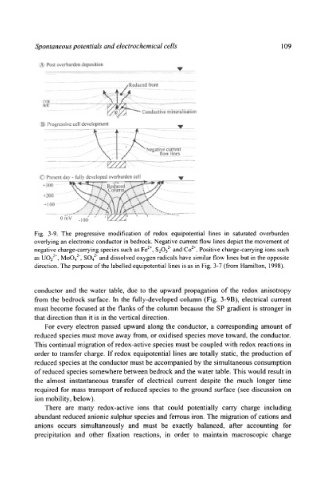
           Fig.  3-9. The  progressive  modification  of  redox equipotential  lines in  saturated  overburden
           overlying an electronic conductor in bedrock. Negative current flow lines depict the movement of
           negative charge-carrying species such as Fe 2+, 82032" and Co 2§  Positive charge-carrying  ions such
           as UO22§  MoO4 2,  SO4 2 and dissolved oxygen radicals have similar flow lines but in the opposite
           direction. The purpose of the labelled equipotential lines is as in Fig. 3-7 (from Hamilton, 1998).


           conductor  and  the  water  table,  due  to  the  upward  propagation  of  the  redox  anisotropy
           from  the  bedrock  surface.  In  the  fully-developed  column  (Fig.  3-9B),  electrical  current
           must become  focused  at the  flanks  of the  column because  the  SP  gradient  is stronger  in
           that direction than  it is in the vertical direction.
              For  every  electron  passed  upward  along  the  conductor,  a  corresponding  amount  of
           reduced  species  must move away from, or oxidised  species  move toward,  the conductor.
           This continual  migration of redox-active species must be coupled with redox reactions  in
           order  to  transfer  charge.  If redox  equipotential  lines  are  totally  static,  the  production  of
           reduced species at the conductor must be accompanied by the simultaneous consumption
           of reduced species somewhere between bedrock and the water table. This would result in
           the  almost  instantaneous  transfer  of  electrical  current  despite  the  much  longer  time
           required  for  mass  transport  of reduced  species  to  the  ground  surface  (see  discussion  on
           ion mobility, below).
              There  are  many  redox-active  ions  that  could  potentially  carry  charge  including
           abundant reduced anionic  sulphur species and ferrous  iron.  The  migration of cations and
           anions  occurs  simultaneously  and  must  be  exactly  balanced,  after  accounting  for
           precipitation  and  other  fixation  reactions,  in  order  to  maintain  macroscopic  charge

