


Page 137 - Geochemical Remote Sensing of The Sub-Surface
P. 137
114                                                           S.M. Hamilton

              1 O0            H §


           ~                                      x-
           ~  ~0
           "0

           0                                          I


                0        2000     4000      6000     800C
                   Time (yeors} for ton  migrotion  through  overburden
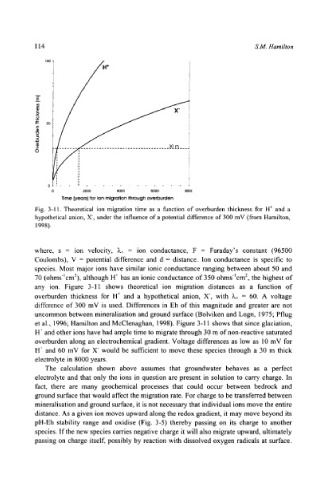
           Fig. 3-11. Theoretical  ion  migration  time  as  a  function  of overburden  thickness  for  H + and  a
           hypothetical  anion,  X,  under the  influence of a potential  difference  of 300 mV (from Hamilton,
           1998).


           where,  s  =  ion  velocity,  ~.+  =  ion  conductance,  F  =  Faraday's  constant  (96500
           Coulombs),  V  =  potential  difference  and  d  =  distance.  Ion  conductance  is  specific  to
           species.  Most  major  ions  have  similar  ionic  conductance  ranging  between  about  50  and
           70  (ohms-lcm2),  although  H + has  an  ionic  conductance  of 350  ohms-lcm 2, the  highest  of
           any  ion.  Figure  3-11  shows  theoretical  ion  migration  distances  as  a  function  of
           overburden  thickness  for  H §  and  a  hypothetical  anion,  X-,  with  k+  =  60.  A  voltage
           difference  of  300  mV  is  used.  Differences  in  Eh  of this  magnitude  and  greater  are  not
           uncommon between mineralisation  and ground surface  (Bolviken  and  Logn,  1975;  Pflug
           et al.,  1996;  Hamilton and McClenaghan,  1998).  Figure  3-11  shows that since  glaciation,
           H + and other ions have had ample time to migrate through 30 m  of non-reactive saturated
           overburden  along  an  electrochemical  gradient.  Voltage  differences  as  low as  10 mV  for
           H + and  60  mV  for  X  would  be  sufficient  to  move  these  species  through  a  30  m  thick
           electrolyte in 8000 years.
              The  calculation  shown  above  assumes  that  groundwater  behaves  as  a  perfect
           electrolyte  and  that  only  the  ions  in  question  are  present  in  solution  to  carry  charge.  In
           fact,  there  are  many  geochemical  processes  that  could  occur  between  bedrock  and
           ground surface  that would affect the migration rate.  For charge to be transferred between
           mineralisation and ground surface,  it is not necessary that individual ions move the entire
           distance.  As a given ion moves upward along the redox gradient,  it may move beyond its
           pH-Eh  stability  range  and  oxidise  (Fig.  3-5)  thereby  passing  on  its  charge  to  another
           species.  If the new species carries negative charge it will also migrate upward, ultimately
           passing  on  charge  itself,  possibly by  reaction  with  dissolved  oxygen  radicals  at surface.

