


Page 134 - Geochemical Remote Sensing of The Sub-Surface
P. 134
Spontaneous potentials  and electrochemical cells                     111


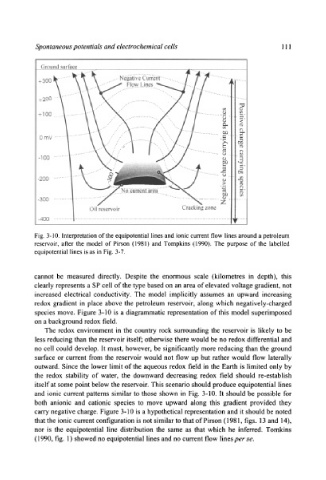
           Fig. 3-10. Interpretation of the equipotential lines and ionic current flow lines around a petroleum
           reservoir, after  the  model of Pirson (1981) and  Tompkins  (1990). The  purpose  of the  labelled
           equipotential lines is as in Fig. 3-7.


           cannot  be  measured  directly.  Despite  the  enormous  scale  (kilometres  in  depth),  this
           clearly represents a SP cell of the type based on an area of elevated voltage gradient,  not
           increased  electrical  conductivity.  The  model  implicitly  assumes  an  upward  increasing
           redox  gradient  in  place  above  the  petroleum  reservoir,  along  which  negatively-charged
           species  move.  Figure 3-10  is a diagrammatic  representation  of this  model  superimposed
           on a background redox field.
              The  redox  environment  in the  country rock surrounding the  reservoir  is  likely to be
           less reducing than the reservoir itself; otherwise there would be no redox differential  and
           no cell  could develop.  It must,  however,  be  significantly more  reducing than  the  ground
           surface  or current  from  the  reservoir would  not  flow  up  but  rather  would  flow  laterally
           outward.  Since the  lower limit of the aqueous  redox  field  in the  Earth  is  limited only by
           the  redox  stability  of  water,  the  downward  decreasing  redox  field  should  re-establish
           itself at some point below the reservoir.  This scenario should produce equipotential  lines
           and  ionic  current  patterns  similar to those  shown  in  Fig.  3-10.  It should be  possible  for
           both  anionic  and  cationic  species  to  move  upward  along  this  gradient  provided  they
           carry negative charge.  Figure 3-10 is a hypothetical representation and it should be noted
           that the ionic current configuration is not similar to that of Pirson (1981, figs.  13 and  14),
           nor  is  the  equipotential  line  distribution  the  same  as  that  which  he  inferred.  Tomkins
           (1990, fig.  1) showed no equipotential lines and no current flow lines per se.

